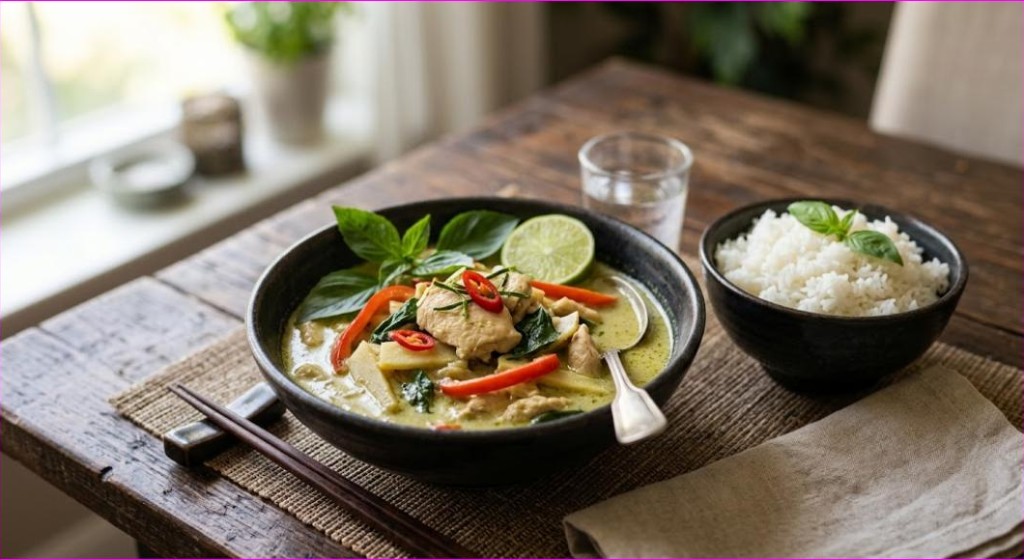
Thai green curry, or gaeng keow wan, gets its colour and heat from fresh green chilies pounded with lemongrass, galangal, kaffir lime and shrimp paste. Made well it is aromatic, layered and balanced across four flavours at once — salty, sweet, sour and hot. Made carelessly it is a bland coconut soup with chicken in it.
The single technique that separates the two is cracking the coconut cream. Before any other liquid goes in, the thick cream from the top of the can is simmered until the oil separates out, and the curry paste is then fried in that oil. Frying the paste in fat releases aromatic compounds that will never come out if you simply stir the paste into coconut milk. It takes five extra minutes and it changes the dish completely.
The second thing is balance. Thai cooking works by adjusting fish sauce, palm sugar and lime at the end until all four flavours sit in tension. Following a recipe exactly and never tasting is why home versions taste flat. This takes 40 minutes and serves four.
- Prep15 min
- Cook25 min
- Total40 min
- Serves4 servings
- CourseMain Course
- CuisineThai
Written by Anisha Akter · Updated 26 September 2026
Why This Thai Green Curry Recipe Works
- The coconut cream is cracked first so the paste can be fried in coconut oil, which is where the aroma comes from.
- Full-fat coconut milk provides the body the sauce needs; light coconut milk cannot crack and will not thicken.
- The chicken poaches gently in the sauce rather than being seared, which keeps it tender.
- Vegetables are added in stages based on how long each one takes.
- The seasoning is adjusted at the end by tasting, which is how Thai food is actually cooked.
Ingredients and Why They Matter
A good store-bought Thai green curry paste is entirely reasonable — look for one with lemongrass and galangal high in the ingredient list. Full list below.
- Two 13.5 oz (400 ml) cans full-fat coconut milk, not shaken
- 4 to 5 tbsp Thai green curry paste
- 1 1/2 lb (680 g) boneless chicken thighs, sliced 1/2 inch thick
- 1 cup (240 ml) chicken stock
- 4 kaffir lime leaves, torn (or zest of 1 lime)
- 1 Thai eggplant or 1 cup diced regular eggplant
- 1 red bell pepper, sliced
- 1 cup (100 g) green beans, trimmed and halved
- 1/2 cup (75 g) bamboo shoots, drained
- 2 1/2 tbsp fish sauce
- 1 1/2 tbsp palm sugar or brown sugar
- 1 tbsp lime juice
- 1 cup Thai basil leaves
- 1 red chili, sliced, to garnish
- Jasmine rice, to serve
Key Ingredient Notes
Full-fat coconut milk. Open the can without shaking it and the thick cream sits on top. That cream is what you crack to release coconut oil. Light coconut milk is mostly water with emulsifiers and will never separate, which means you lose the most important step in the recipe.
Green curry paste. Fresh homemade paste is best, but a good jarred Thai brand is genuinely close. Start with four tablespoons and add more if you want heat; brands vary enormously in strength, so taste as you go.
Kaffir lime leaves. These give green curry its distinctive citrus perfume, quite different from lime juice. Tear them rather than chopping to release the oils. If you cannot find them, lime zest is a partial substitute but not the same thing.
Thai basil. Sweeter and more anise-like than Italian basil, with purple stems. Added at the very end off the heat so the aroma survives. Italian basil works in a pinch but the flavour profile shifts noticeably.
Step-by-Step Instructions
- Open one can of coconut milk without shaking and spoon the thick cream from the top into a wok or wide pan. You want about 3/4 cup of thick cream.
- Heat the cream over medium-high, stirring, for 4 to 6 minutes. It will bubble, then thicken, then visibly separate as clear oil pools at the edges. This is cracking, and it is the step most recipes skip.
- Add the curry paste to the separated oil and fry it, stirring constantly, for 2 to 3 minutes. It will darken and become intensely fragrant. If the pan looks dry, add another spoonful of coconut cream.
- Add the sliced chicken and stir to coat it in the paste. Cook 3 minutes.
- Pour in the rest of the first can, the whole second can, and the chicken stock. Add the torn kaffir lime leaves. Bring to a gentle simmer.
- Add the eggplant and simmer 6 to 8 minutes, until it starts to soften.
- Add the green beans and simmer 4 minutes.
- Add the bell pepper and bamboo shoots and simmer 3 minutes more, until the chicken is cooked through and the vegetables are tender but still have some bite.
- Stir in the fish sauce, palm sugar and lime juice. Now taste. It should be salty, slightly sweet, sour and hot all at once. Add more fish sauce for salt, sugar for sweetness, lime for sourness, or paste for heat until it tastes balanced rather than dominated by any one flavour.
- Turn off the heat and stir in the Thai basil, which will wilt in seconds.
- Serve over jasmine rice, garnished with sliced red chili and a few extra basil leaves.
Common Mistakes and How to Avoid Them
Not cracking the coconut cream Stirring the paste into coconut milk gives you a pale, flat curry. Frying the paste in separated coconut oil is what releases the aromatic compounds. Take the five minutes.
Using light coconut milk Light coconut milk is diluted and stabilised so it cannot separate. Without separation there is no oil to fry the paste in, and the sauce stays thin. Use full fat.
Not tasting and adjusting at the end Thai cooking is seasoned by taste, not by measurement. Curry pastes vary in salt and heat, limes vary in sourness. The fish sauce, sugar and lime quantities here are a starting point, not a rule.
Adding all the vegetables at once Eggplant needs eight minutes, peppers need three. Everything in together means either raw eggplant or collapsed peppers. Stage them.
Tips for Best Results
- Use a wide pan rather than a deep pot. More surface area means the cream cracks faster and the sauce reduces properly.
- If the curry tastes harsh or one-dimensional, it usually needs sugar rather than salt. Palm sugar rounds off the edges of chili heat.
- Save a few tablespoons of thick coconut cream to drizzle over each bowl at the table. It looks good and adds a fresh dairy-like richness.
- Thai eggplants look like small green golf balls and hold their shape better than regular eggplant. Asian grocers usually carry them.
- Make extra sauce and freeze it without the vegetables. A fresh curry then takes ten minutes.
Variations to Try
Vegetarian green curry. Use a vegan curry paste, substitute soy sauce or light miso for the fish sauce, and use tofu, mushrooms and squash in place of the chicken.
Shrimp green curry. Add 1 lb of peeled shrimp in the final three minutes. They cook very fast and turn rubbery if simmered.
Red curry. Swap the paste for Thai red curry paste. The method is identical and the result is deeper and slightly sweeter.
Beef green curry. Use thinly sliced sirloin, added in the last four minutes so it does not toughen.
Storage, Freezing and Reheating
Refrigerate for up to 3 days. The flavour deepens overnight, though the vegetables soften.
Reheat gently over low heat. Boiling can cause the coconut milk to separate, though stirring usually brings it back.
Freeze for up to 2 months. Coconut milk can look grainy after thawing; reheat slowly and stir well. Add fresh basil after reheating.
What to Serve With It
Frequently Asked Questions
What does cracking the coconut cream mean?
Simmering the thick cream from the top of the can until the water evaporates and the coconut oil separates out visibly. You then fry the curry paste in that oil, which releases far more aroma than stirring it into liquid.
Why is my green curry bland?
Almost always because the paste was not fried in oil first, or because the final seasoning was never adjusted. Fry the paste properly, then taste and balance fish sauce, sugar and lime at the end.
Can I use light coconut milk?
Not for this method. Light coconut milk cannot separate, so you lose the frying step and the sauce stays thin. Use full-fat, and thin the finished curry with stock if you want it lighter.
Is store-bought curry paste acceptable?
Yes. Good Thai brands are made with the same ingredients a home cook would pound. Check that lemongrass, galangal and green chili appear near the top of the ingredient list.
How do I make green curry less spicy?
Use less paste and more coconut milk, and increase the palm sugar slightly. Sugar and fat both blunt chili heat. Serve with plenty of plain jasmine rice.
What is the difference between green, red and yellow Thai curry?
Green uses fresh green chilies and is usually the hottest and most herbal. Red uses dried red chilies and is deeper and slightly sweeter. Yellow includes turmeric and curry powder and is the mildest.

Hi! I’m the creator of scooks (Simple Cooks).I share easy, practical recipes and simple cooking ideas to help you enjoy everyday home cooking with confidence.
Happy cooking! 🍽️