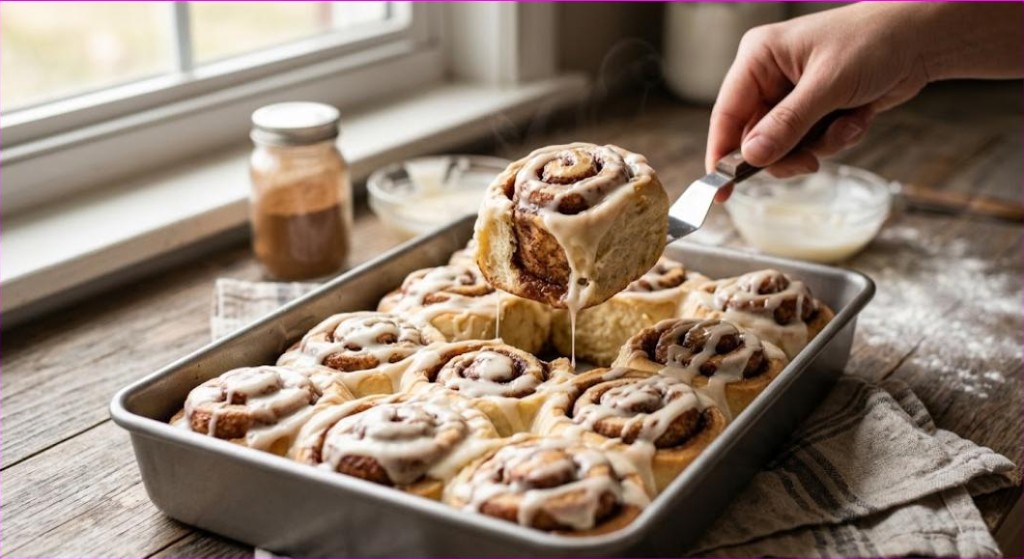
A good cinnamon roll is soft enough to pull apart with your fingers, with a centre that is slightly underdone and gooey and a spiral that holds together rather than unwinding into a puddle of butter. Most homemade versions come out dense, dry by the second day, or sitting in a pool of leaked filling.
Three techniques fix all of that. A tangzhong — a cooked flour-and-milk paste stirred into the dough — lets the dough hold far more water than it otherwise could, which is why tangzhong rolls stay soft for days instead of hours. Chilling the filled log before slicing keeps the butter solid so the spiral stays tight. And pulling the rolls at the right moment, when the centres are just barely set, is what gives you that gooey middle.
This makes twelve rolls in a 9×13 pan. Active time is about forty minutes; the rest is rising. You can do the shaping the night before and bake them in the morning, which is how most people will actually want to make them.
- Prep40 min
- Cook25 min
- Total1 hr 5 min
- Serves12 rolls
- CourseBreakfast
- CuisineAmerican
Written by Anisha Akter · Updated 25 September 2026
Why This Cinnamon Rolls Recipe Works
- A tangzhong pre-gelatinises some of the flour so the dough absorbs extra liquid, producing a soft crumb that resists staling.
- An enriched dough with egg, butter and milk gives tenderness and flavour that a lean dough cannot.
- Chilling the filled log before slicing keeps the butter firm, so the layers stay distinct and the filling stays in.
- Cutting with unflavoured dental floss gives clean rounds instead of squashed ovals.
- The rolls are baked until just set in the centre, which is what makes them gooey rather than bready.
Ingredients and Why They Matter
The tangzhong is made from flour and milk already in the recipe, so it adds a step but no ingredients. Full list below.
- For the tangzhong: 3 tbsp (25 g) bread flour + 1/2 cup (120 ml) whole milk
- 3 1/4 cups (400 g) bread flour
- 1/4 cup (50 g) granulated sugar
- 2 1/4 tsp instant yeast (1 packet)
- 1 tsp salt
- 1/2 cup (120 ml) whole milk, warmed to 110°F
- 1 large egg plus 1 yolk, room temperature
- 4 tbsp (55 g) unsalted butter, softened
- For the filling: 6 tbsp (85 g) butter, very soft; 3/4 cup (160 g) packed brown sugar; 2 tbsp ground cinnamon; pinch of salt
- For the icing: 4 oz (115 g) cream cheese, softened; 3 tbsp butter, softened; 1 cup (120 g) powdered sugar; 1 tsp vanilla; 1 to 2 tbsp milk
Key Ingredient Notes
Bread flour. Higher protein means stronger gluten, which is what lets an enriched dough rise tall and hold its spiral. All-purpose flour works but gives a slightly denser, less chewy roll.
The tangzhong. Cooking a small portion of the flour with milk into a thick paste gelatinises the starch, allowing it to hold roughly three times its weight in water. That extra moisture stays locked in the crumb as the rolls cool, which is why they are still soft on day three.
Very soft, not melted, filling butter. Softened butter spreads into a paste that grips the dough. Melted butter runs to the edges and pools out during baking, taking the sugar with it. This is the most common cause of leaked filling.
Cream cheese in the icing. Plain powdered-sugar glaze is sweet and one-dimensional. Cream cheese adds acidity and salt that balance a very sweet roll. Let it come fully to room temperature or the icing will be lumpy.
Step-by-Step Instructions
- Make the tangzhong: whisk the 3 tablespoons of bread flour with the 1/2 cup of milk in a small saucepan over medium heat, stirring constantly, for 2 to 3 minutes until it thickens into a pudding-like paste. Scrape into a bowl and cool to lukewarm.
- In a stand mixer bowl, combine the remaining bread flour, sugar, yeast and salt. Add the cooled tangzhong, the warm milk, the egg and yolk.
- Mix with the dough hook on low for 2 minutes until a shaggy dough forms, then knead on medium-low for 5 minutes.
- Add the softened butter a tablespoon at a time, letting each piece incorporate before adding the next. Knead 8 to 10 minutes more until the dough is smooth, elastic and pulls away from the bowl sides. It will be soft and slightly tacky, which is correct.
- Transfer to a greased bowl, cover, and rise in a warm place for 60 to 90 minutes until doubled. Press a floured finger into the dough — if the dent stays, it is ready.
- Mix the filling ingredients into a spreadable paste.
- Turn the dough onto a lightly floured surface and roll it into a rectangle about 16 by 12 inches. Spread the filling evenly right to the edges on three sides, leaving a 1/2-inch clean border along one long edge.
- Roll up tightly from the long edge toward the clean border, keeping even tension. Pinch the seam to seal and place the log seam-side down.
- Wrap the log and chill it for 20 to 30 minutes. Cold butter means clean slices and no leaking.
- Slice into 12 equal rolls using a length of unflavoured dental floss: slide it under the log, cross the ends over the top, and pull. Arrange cut-side up in a buttered 9×13 pan with space between them.
- Cover and rise 45 to 60 minutes until puffy and touching. Meanwhile heat the oven to 350°F (175°C).
- Bake 22 to 27 minutes, until the tops are golden and the centre roll reads about 190°F. Tent with foil if they brown too fast.
- Beat the icing ingredients until smooth and spread over the rolls while they are still warm but not hot, so it melts into the crevices without running off entirely.
Common Mistakes and How to Avoid Them
Melting the filling butter Melted butter slides out during baking, leaving a burnt sugar pool in the pan and a dry spiral. The butter should be soft enough to spread like frosting but still opaque and thick.
Adding hot milk to the yeast Liquid above about 120°F kills yeast. Warm the milk to roughly 110°F — comfortably warm on your wrist, not hot. If the dough does not rise at all, this is usually why.
Over-baking A cinnamon roll baked to a firm, fully dry centre is a bread roll. Pull them when the centres are just set and still look slightly underdone; carryover heat finishes them in the pan.
Slicing with a knife A knife presses down and squashes the spiral into an oval, sealing the layers together. Dental floss cuts cleanly through without compressing anything.
Tips for Best Results
- Weigh the flour if you can. A cup of flour can vary by 20 percent depending on how it is scooped, and enriched doughs are sensitive to that.
- If your kitchen is cold, proof the dough in the oven with only the light on. It holds about 80°F, which is close to ideal.
- Pour 1/4 cup of heavy cream over the risen rolls just before baking. It makes the bottoms extraordinarily soft and creates a light caramel in the pan.
- Mark the log before slicing: cut it in half, then each half in half, then each quarter into three. You get twelve even rolls without measuring.
Variations to Try
Overnight cinnamon rolls. After slicing and arranging in the pan, cover and refrigerate overnight. In the morning let them sit at room temperature for 45 minutes, then bake as directed.
Orange rolls. Replace the cinnamon in the filling with the zest of two oranges, and add orange zest and juice to the icing in place of the milk.
Caramel pecan rolls. Pour a butter, brown sugar and cream mixture into the pan with toasted pecans before adding the rolls. Invert the pan after baking.
Chocolate rolls. Swap half the brown sugar for cocoa powder and scatter chopped dark chocolate over the filling before rolling.
Storage, Freezing and Reheating
Store covered at room temperature for up to 3 days. The tangzhong is what keeps them soft this long; a standard dough would be stale by day two.
Reheat individual rolls in the microwave for 15 to 20 seconds, which brings back the just-baked texture remarkably well.
Freeze baked and un-iced rolls for up to 2 months. Thaw at room temperature, warm in a 300°F oven for 10 minutes, then ice. You can also freeze the shaped unbaked rolls and thaw overnight in the fridge before the final rise.
What to Serve With It
Frequently Asked Questions
Why did my cinnamon rolls turn out dry?
Usually over-baking, too much flour, or no tangzhong. Bake until the centre is just set, weigh your flour, and use the tangzhong step — it is what keeps the crumb moist for days.
Why did the filling leak out?
The butter was melted rather than softened, or the log was sliced warm. Use spreadable but solid butter and chill the filled log for twenty minutes before cutting.
Can I make cinnamon rolls the night before?
Yes. Shape and slice them, arrange in the pan, cover and refrigerate overnight. Let them sit out for 45 minutes in the morning, then bake.
How do I know when the dough has risen enough?
Press a floured finger about half an inch into the dough. If the indentation springs back fully, it needs more time; if it stays, it is ready. If the dough collapses, it has over-proofed.
Can I use all-purpose flour instead of bread flour?
Yes. The rolls will be slightly softer and less chewy, and the dough will be a little slacker to handle. Reduce the milk by a tablespoon if it feels too wet.
What is a tangzhong and do I need it?
It is a cooked paste of flour and milk stirred into the dough. It lets the dough hold more water, which keeps the rolls soft far longer. You can skip it, but expect the rolls to stale by the next day.

Hi! I’m the creator of scooks (Simple Cooks).I share easy, practical recipes and simple cooking ideas to help you enjoy everyday home cooking with confidence.
Happy cooking! 🍽️