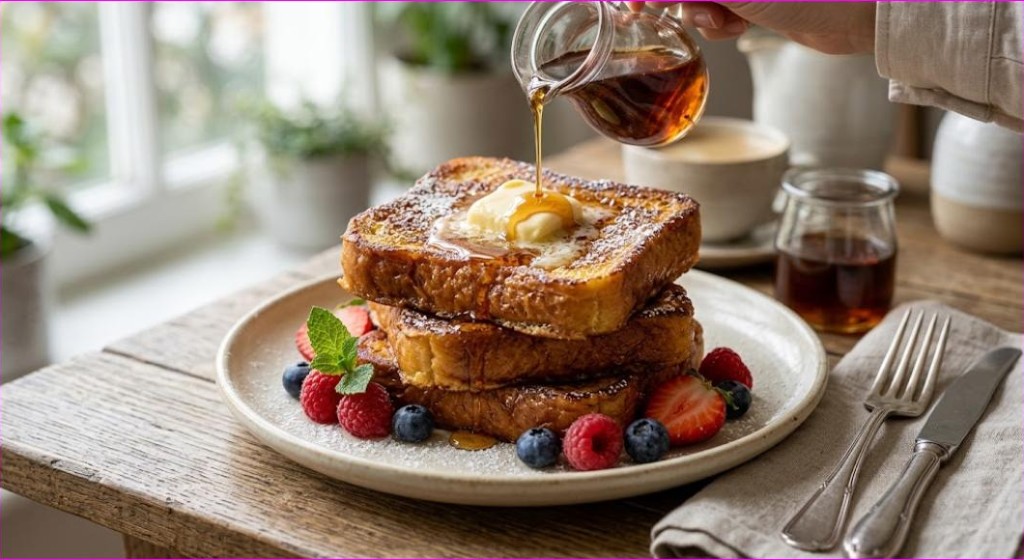
French toast is bread soaked in custard and fried. That is the whole recipe, which is exactly why it goes wrong so often — there is nothing to hide behind. The two outcomes people complain about are a soggy middle that never sets, and a dry, eggy slab that tastes like a sweet omelette.
Both come from the same pair of variables: the bread and the soak. Fresh soft sandwich bread has no structure to hold custard, so it collapses. Dense stale bread needs a longer soak than most recipes allow, so the centre stays dry. Match the soak time to the bread and the problem disappears.
The third variable is pan temperature. Too hot and the outside browns in ninety seconds while the custard inside is still liquid. Medium heat and a patient four minutes a side gives you the crisp exterior and set, creamy centre that good French toast is supposed to have. This takes 25 minutes and serves four.
- Prep10 min
- Cook15 min
- Total25 min
- Serves4 servings
- CourseBreakfast
- CuisineAmerican
Written by Anisha Akter · Updated 24 September 2026
Why This French Toast Recipe Works
- Thick-cut day-old bread has the structure to absorb custard without disintegrating.
- A custard with more yolk than white sets creamy rather than rubbery.
- A pinch of salt and a splash of vanilla keep the custard from tasting flat and eggy.
- Cooking in butter over medium heat browns the surface slowly, giving the inside time to set.
- Finishing in a warm oven holds a batch at the right texture without steaming it soft.
Ingredients and Why They Matter
Brioche and challah are the classic choices because their enriched, open crumb drinks custard without falling apart. Here is the full list.
- 8 slices day-old brioche or challah, cut 3/4 to 1 inch thick
- 4 large eggs
- 2 large egg yolks
- 1 1/4 cups (300 ml) whole milk
- 1/4 cup (60 ml) heavy cream
- 2 tbsp granulated sugar
- 1 1/2 tsp vanilla extract
- 1/2 tsp ground cinnamon
- 1/4 tsp freshly grated nutmeg
- 1/4 tsp salt
- 3 tbsp butter, for the pan
- Maple syrup, powdered sugar and berries, to serve
Key Ingredient Notes
Day-old brioche or challah. Enriched breads have an open, eggy crumb that soaks up custard and holds it. A day of drying out firms the structure so the slices do not fall apart in the dish. Thin supermarket sandwich bread has neither the thickness nor the strength.
Extra egg yolks. Yolks set softer and richer than whites. A custard made only with whole eggs sets firm and tastes distinctly of egg; adding two extra yolks shifts the texture toward creamy and the flavour toward vanilla and dairy.
Whole milk with a little cream. Skim milk produces a thin custard that soaks in fast and sets weakly. Whole milk plus a splash of cream gives enough fat for a custardy set without making the toast heavy.
A quarter teaspoon of salt. Salt in a sweet custard is not there to make it salty. It suppresses the sulfurous note of cooked egg and sharpens the vanilla and cinnamon. Leave it out and the toast tastes noticeably duller.
Step-by-Step Instructions
- If your bread is fresh, spread the slices on a rack and leave them out for a few hours, or dry them in a 200°F oven for 10 minutes and cool.
- Whisk the eggs and yolks in a wide shallow dish until completely smooth and uniform in colour, with no streaks of white remaining.
- Whisk in the milk, cream, sugar, vanilla, cinnamon, nutmeg and salt until fully combined.
- Heat the oven to 200°F (95°C) and set a wire rack on a baking sheet inside. This is where cooked slices will wait.
- Lay two slices in the custard and soak for 20 to 30 seconds per side for standard thickness, or up to 45 seconds per side for very dense or very stale bread. The slice should feel heavy and saturated but not fall apart when lifted.
- Lift each slice and let the excess custard drip off for a few seconds. Dripping slices put too much liquid in the pan, which steams rather than browns.
- Melt about 2 teaspoons of butter in a large skillet or on a griddle over medium heat. It should foam but not brown immediately.
- Cook two slices at a time for 3 to 4 minutes on the first side, without moving them, until deep golden.
- Flip and cook 3 to 4 minutes more. The centre is done when the slice feels springy rather than squishy when pressed in the middle.
- Transfer to the rack in the warm oven and repeat with the remaining slices, adding fresh butter each time and wiping out any burnt residue between batches.
- Serve hot with maple syrup, a dusting of powdered sugar and berries.
Common Mistakes and How to Avoid Them
Using thin, fresh sandwich bread Soft fresh bread turns to paste in custard and fries into a limp, greasy square. Thick slices of day-old enriched bread are the single biggest upgrade available.
Cooking on high heat High heat browns the surface in under two minutes while the custard inside is still raw, which is exactly the soggy-centre complaint. Medium heat and four minutes a side lets the inside set as the outside colours.
Under-whisking the eggs Streaks of unbeaten white cook into visible rubbery patches on the finished toast. Whisk the eggs alone first until completely uniform, then add the dairy.
Over-soaking Bread left in custard for several minutes absorbs more liquid than it can support and disintegrates in the pan. Twenty to forty-five seconds a side is the working range, adjusted to how dry the bread is.
Tips for Best Results
- Use a wide shallow dish, not a bowl. It lets you soak slices flat and evenly rather than bending them.
- Wipe the pan between batches. Burnt butter and stray custard turn bitter and mark the later slices.
- For the crispest edges, dip the soaked slice briefly in a plate of granulated sugar before it goes in the pan. The sugar caramelises into a thin crust.
- A splash of orange zest or a tablespoon of bourbon in the custard adds a background note that makes people ask what is different.
- Warm the maple syrup. Cold syrup on hot toast drops the temperature immediately.
Variations to Try
Stuffed French toast. Sandwich two slices around sweetened cream cheese and jam, then soak and cook the whole sandwich. Needs an extra minute per side.
Baked French toast casserole. Layer cubed bread in a dish, pour over the custard, refrigerate overnight and bake at 350°F for 45 minutes. Ideal for feeding a crowd.
Savoury French toast. Leave out the sugar, vanilla and spices; add black pepper, grated Parmesan and chives. Serve with a fried egg.
Dairy-free version. Use full-fat oat milk or coconut milk in place of the dairy and cook in coconut oil. The custard sets slightly softer.
Storage, Freezing and Reheating
Refrigerate cooked French toast for up to 3 days in an airtight container with parchment between slices.
Reheat in a 350°F oven on a wire rack for 8 to 10 minutes, or in a toaster. Microwaving makes it limp.
Freeze cooked slices in a single layer, then bag them, for up to 2 months. Reheat straight from frozen in a toaster or a 375°F oven for 10 minutes.
What to Serve With It
Frequently Asked Questions
Why is my French toast soggy in the middle?
Either the pan was too hot, so the outside cooked before the inside set, or the bread was too soft and absorbed more custard than it could support. Cook on medium heat for three to four minutes a side and use thick day-old bread.
What is the best bread for French toast?
Brioche and challah are the best, with their rich, open crumb. Thick-cut Texas toast, sourdough and French bread all work. Avoid thin, soft supermarket sandwich bread.
How long should I soak the bread?
Twenty to thirty seconds per side for standard day-old slices; up to forty-five seconds for very dry or dense bread. The slice should feel saturated but still hold together when lifted.
Can I make French toast custard ahead?
Yes. Whisk the custard up to two days ahead and refrigerate it. Whisk again before using. Do not soak the bread in advance unless you are making an overnight casserole.
Why does my French toast taste eggy?
Too many whole eggs relative to dairy, no salt, and not enough vanilla. Adding extra yolks instead of whole eggs, plus a quarter teaspoon of salt, shifts the flavour away from egg.
Should I use milk or cream?
Whole milk with a splash of cream is the best balance. All cream makes the toast heavy and can taste greasy; skim milk gives a weak, watery set.

Hi! I’m the creator of scooks (Simple Cooks).I share easy, practical recipes and simple cooking ideas to help you enjoy everyday home cooking with confidence.
Happy cooking! 🍽️