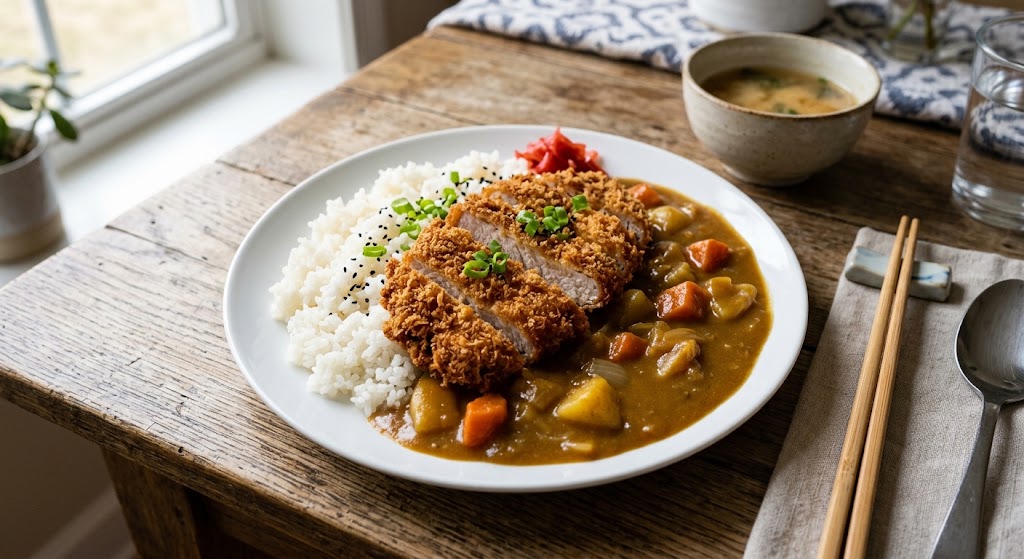
Japanese katsu curry is a beloved comfort dish in Japan, combining crispy breaded pork cutlets called tonkatsu with a thick, mildly spiced curry sauce served over steamed rice. This dish originated in Japan in the early 20th century as a fusion of Western-style breaded fried meat and Indian-influenced Japanese curry, becoming a staple in homes and restaurants alike.
A common challenge when making katsu curry at home is achieving a crispy, non-greasy tonkatsu while preparing a curry sauce that is thick and flavorful without being too salty or bland. The curry roux requires careful preparation to develop depth, and the breading process demands control of oil temperature to avoid soggy or burnt cutlets.
This recipe delivers a complete katsu curry experience with tender, crispy pork cutlets and a balanced curry sauce ready in approximately 80 minutes, serving four people. It guides you through preparing the curry roux from scratch and frying the tonkatsu with precise temperature control, ensuring a successful dish.
- Prep35 min
- Cook45 min
- Total1 hr 20 min
- Serves4 servings
- CourseMain Course
- CuisineJapanese
Written by Anisha Akter · Updated 12 September 2026
A note on method: Garam masala is not traditional in Japanese curry and is omitted here to maintain authenticity, as Japanese curry uses a milder curry powder blend instead.
Why This Katsu Curry Recipe Works
- Making curry roux by gently cooking flour and fat together allows starch gelatinization and Maillard reactions, producing a smooth, flavorful thickener.
- Resting the pork cutlets after pounding evens thickness, which ensures uniform cooking and tenderness.
- Dredging the cutlets in flour before dipping in egg and panko creates a dry surface for the coating to adhere properly and form a crispy crust.
- Frying tonkatsu at a controlled oil temperature of 320-340 °F (160-170 °C) prevents excessive oil absorption and promotes even browning.
- Simmering the curry sauce after adding roux allows the starch to fully gelatinize and the flavors to meld, resulting in a thick, balanced curry.
Ingredients and Why They Matter
The ingredients include components for homemade curry roux, tonkatsu pork cutlets, and the curry sauce base.
- 1 lb (450 g) boneless pork loin chops, about 1 inch thick
- Salt and freshly ground black pepper, to taste
- ½ cup (60 g) all-purpose flour, for dredging
- 1 large egg, beaten
- 1 ½ cups (150 g) panko bread crumbs
- Vegetable oil, for frying (about 4 cups / 1 L)
- 2 tbsp (30 g) unsalted butter
- 2 tbsp (16 g) all-purpose flour
- 1 tbsp (8 g) curry powder (medium heat)
- 1 tsp (5 g) turmeric powder
- 1 tsp (5 g) sugar
- 1 small onion, finely chopped (about 100 g)
- 2 cloves garlic, minced
- 1 tsp (5 ml) grated fresh ginger
- 2 medium carrots, peeled and cut into 1/2-inch (1 cm) rounds
- 2 medium potatoes, peeled and cut into 1-inch (2.5 cm) chunks
- 3 cups (720 ml) chicken stock or water
- 2 tbsp (30 ml) soy sauce
- 1 tbsp (15 ml) Worcestershire sauce
- Steamed Japanese short-grain rice, to serve (about 4 cups cooked)
Key Ingredient Notes
Panko bread crumbs — Panko’s coarser, airy texture creates a lighter, crispier crust than regular breadcrumbs by allowing hot oil to circulate, reducing oil absorption; if unavailable, Japanese-style dried bread crumbs or fresh breadcrumbs toasted in a dry pan can substitute but produce denser crusts.
Curry powder — A blend of turmeric, coriander, cumin, and fenugreek with mild heat, Japanese curry powder provides the characteristic warm aroma and flavor; substituting with generic curry powder is possible but may lack balance, so adjust spice quantities accordingly.
Chicken stock — Using chicken stock instead of water adds umami depth and richness to the curry sauce, enhancing mouthfeel and complexity; vegetable stock is a suitable substitute for a vegetarian option but alters flavor slightly.
Soy sauce — Soy sauce contributes saltiness and umami, balancing sweetness and spice in the curry sauce; use low-sodium soy sauce to control salt level and avoid overpowering the dish.
Step-by-Step Instructions
- Begin by pounding the pork loin chops gently with a meat mallet or rolling pin to an even thickness of about ½ inch (1.2 cm); this promotes uniform cooking and tenderness.
- Season both sides of the pork cutlets with salt and freshly ground black pepper evenly.
- Prepare three shallow dishes for dredging: one with flour, one with beaten egg, and one with panko bread crumbs; coat each cutlet first in flour, shaking off excess, then dip into egg, and finally press firmly into panko to fully cover.
- Pour vegetable oil into a deep, heavy-bottomed pot or Dutch oven to a depth of about 2 inches (5 cm) and heat over medium heat until the temperature reaches 320-340 °F (160-170 °C) measured with a thermometer; maintain this temperature during frying.
- Fry the breaded pork cutlets one or two at a time, depending on pot size, to avoid overcrowding; cook for 4-5 minutes per side until the crust is golden brown and an internal temperature of 145 °F (63 °C) is reached; transfer to a wire rack to drain excess oil.
- In a medium saucepan, melt butter over medium heat and add the flour; cook, stirring constantly for 3-4 minutes until the mixture turns light brown and smells nutty, forming the curry roux base.
- Add curry powder, turmeric, and sugar to the roux and stir for 1 minute to release aromas without burning the spices.
- In a separate large pot, heat 1 tablespoon of vegetable oil over medium heat; add chopped onion and sauté for 5-7 minutes until translucent and starting to brown.
- Add minced garlic and grated ginger to the onions and cook for 1 minute until fragrant, stirring constantly to avoid burning.
- Add carrots and potatoes to the pot and stir to coat them in the aromatics, cooking for 2 minutes.
- Pour in the chicken stock, soy sauce, and Worcestershire sauce; bring to a gentle simmer, then reduce heat to medium-low and cook uncovered for 15-20 minutes until vegetables are tender.
- Gradually whisk the prepared curry roux into the simmering pot; continue cooking on low heat, stirring frequently, until the sauce thickens to a gravy consistency, about 5-10 minutes.
- Slice the fried pork cutlets into 1-inch (2.5 cm) strips and plate over steamed Japanese rice; ladle the hot curry sauce generously over the cutlets and serve immediately.
Food safety note: Ensure the pork loin reaches an internal temperature of 145 °F (63 °C) followed by a 3-minute rest period to guarantee safe consumption, as recommended by FoodSafety.gov. Maintain proper oil temperatures during frying to avoid undercooking or excess oil absorption.
Common Mistakes and How to Avoid Them
Using too high oil temperature for frying
Frying the tonkatsu at too high a temperature causes the coating to burn before the interior cooks, resulting in a bitter flavor and raw pork inside; maintain oil between 320-340 °F (160-170 °C) and monitor with a thermometer.
Skipping the flour dredge
Omitting the flour step prevents the egg and panko from adhering properly, leading to uneven coating and poor crust formation; always dredge cutlets in flour before egg and panko to create a dry surface for the breading to stick.
Adding curry roux all at once without whisking
Dumping curry roux into the sauce at once causes lumps and uneven thickening; add curry roux gradually while whisking constantly to ensure smooth incorporation and even thickening.
Overcrowding the frying pan
Placing too many cutlets in the oil drops the temperature abruptly, causing greasy, soggy breading rather than crisp crust; fry one or two cutlets at a time depending on pan size, and allow temperature to recover between batches.
Tips for Best Results
- Dry the pork cutlets with paper towels before dredging to improve breading adhesion and crispness.
- Use a wire rack instead of paper towels to drain fried tonkatsu to maintain crust crispness by preventing steam buildup.
- Grate the carrots finely if you prefer faster cooking and a smoother texture in the curry sauce.
- Make the curry roux ahead and refrigerate it for up to 3 days to save time when cooking.
- Serve with pickled red ginger (beni shoga) or fukujinzuke for traditional flavor contrast.
Variations to Try
Chicken Katsu Curry — Substitute pork loin chops with boneless, skinless chicken thighs or breasts prepared identically; adjust frying time to 3-4 minutes per side until internal temperature reaches 165 °F (74 °C).
Vegetarian Curry with Tofu Katsu — Replace pork with firm tofu sliced and breaded the same way; use vegetable stock and omit Worcestershire sauce or use vegan alternative.
Spicy Katsu Curry — Add 1 teaspoon cayenne pepper to the curry roux and increase curry powder by 1 tablespoon for a pronounced heat level.
Gluten-Free Katsu Curry — Use rice flour instead of all-purpose flour for dredging and roux; substitute gluten-free panko or crushed rice crackers; ensure Worcestershire sauce is gluten-free.
Storage, Freezing and Reheating
- Store leftover curry sauce separately in an airtight container in the refrigerator for up to 4 days.
- Reheat curry sauce gently over low heat, stirring occasionally to prevent scorching; add water or stock if it thickened too much.
- Fried tonkatsu is best eaten fresh but can be refrigerated for 1 day; reheat in a 350 °F (175 °C) oven on a wire rack to restore crispness.
- Avoid freezing fried tonkatsu as thawing causes sogginess; curry sauce can be frozen for up to 2 months in a sealed container.
Serve it with
Frequently Asked Questions
Can I use chicken instead of pork for Japanese katsu curry?
Yes, chicken thighs or breasts can be breaded and fried using the same method; adjust frying times to ensure chicken reaches 165 °F (74 °C) internal temperature for safety.
How do I make the curry sauce thicker?
Thicken the curry sauce by cooking the roux longer to brown slightly before adding liquid, and simmer the sauce uncovered to reduce and concentrate; avoid adding roux all at once to prevent lumps.
What type of rice is best for serving katsu curry?
Short-grain Japanese rice is preferred for its stickiness and texture, which complements the curry and cutlet by holding sauce and providing a tender bite.
Can I prepare katsu curry ahead of time?
You can make the curry sauce in advance and refrigerate or freeze it; fry tonkatsu fresh or reheat in the oven to preserve crispness before serving.
Why is my tonkatsu soggy?
Sogginess results from oil temperature too low, causing excessive oil absorption, or draining on paper towels that trap steam; use a wire rack and maintain proper frying temperature.
Can I use pre-made Japanese curry roux blocks instead of homemade roux?
Yes, pre-made curry roux blocks can be used for convenience and consistent flavor, but making roux from scratch allows control over spice levels and reduces additives.

Hi! I’m the creator of scooks (Simple Cooks).I share easy, practical recipes and simple cooking ideas to help you enjoy everyday home cooking with confidence.
Happy cooking! 🍽️