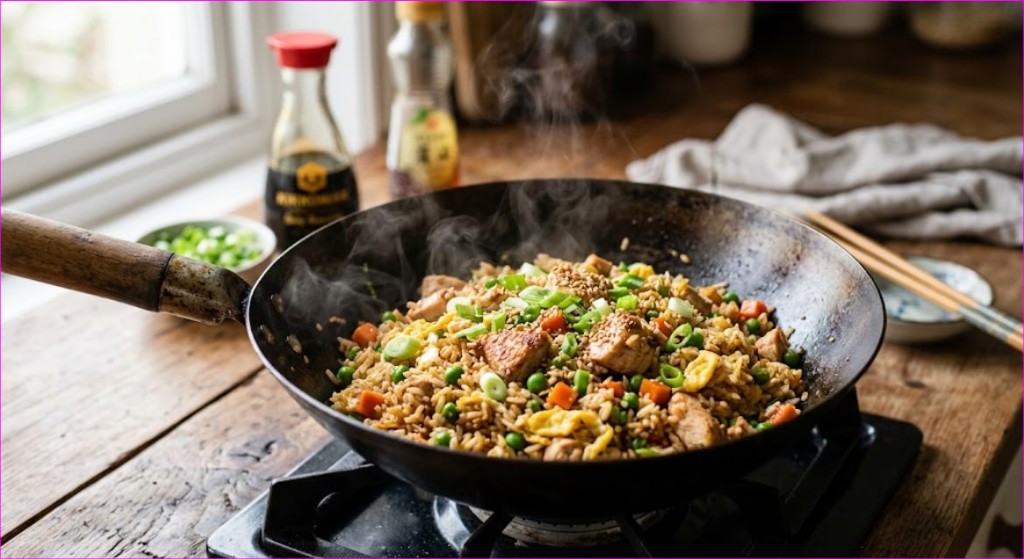
Fried rice is a leftovers dish that became a restaurant staple, and the gap between the two versions is almost entirely about the rice itself. Restaurant fried rice has separate grains with a slight chew and a faint toasted flavour. Home fried rice is often a soft, sticky mound that tastes mainly of soy sauce.
The fix is not more skill. It is drier rice, a hotter pan, and less liquid. Freshly cooked rice carries surface moisture that turns to steam in the pan, and steam is the enemy of frying. Day-old refrigerated rice has dried out and its starches have retrograded, which is why the grains stay separate.
This recipe takes twelve minutes of cooking once everything is prepped, feeds four, and works with whatever vegetables and protein you have. What follows is the method plus the four specific mistakes that turn fried rice into rice porridge.
- Prep15 min
- Cook12 min
- Total27 min
- Serves4 servings
- CourseMain Course
- CuisineChinese-American
Written by Anisha Akter · Updated 23 September 2026
Why This Chicken Fried Rice Recipe Works
- Cold day-old rice has lost surface moisture, so the grains fry rather than steam.
- The eggs are scrambled first and removed, which keeps them in distinct fluffy curds instead of coating every grain.
- Everything is cooked in stages over high heat so nothing sits in the pan releasing water.
- Soy sauce is added around the edge of the hot pan, where it caramelises instead of pooling.
- Sesame oil goes in off the heat, preserving its aroma, which high heat destroys.
Ingredients and Why They Matter
Long-grain rice, cooked at least a day ahead and refrigerated uncovered, is the foundation. Here is everything else.
- 4 cups cooked long-grain rice, cold (about 1 1/3 cups uncooked)
- 1 lb (450 g) boneless chicken thighs, cut into 1/2-inch pieces
- 3 large eggs, beaten
- 3 tbsp neutral oil, divided
- 1 medium onion, diced
- 3 cloves garlic, minced
- 1 cup (140 g) frozen peas and carrots
- 3 scallions, sliced, whites and greens separated
- 3 tbsp soy sauce
- 1 tbsp oyster sauce (optional)
- 1 tsp toasted sesame oil
- 1/2 tsp white pepper
- Salt to taste
Key Ingredient Notes
Day-old cold rice. This is not a suggestion. Warm rice has moist, soft grains that break and clump under a spatula. Chilled rice has firm grains that separate. If you must use fresh rice, spread it on a sheet pan and refrigerate it uncovered for at least an hour.
Long-grain rice. Jasmine or standard long-grain has less amylopectin than short-grain, which means less stickiness. Sushi rice and arborio will clump no matter what you do.
White pepper. White pepper is the background warmth in nearly every Chinese takeout fried rice. It is earthier and less sharp than black pepper. Half a teaspoon is enough to notice without identifying it.
Toasted sesame oil, added last. Sesame oil has a low smoke point and its aroma compounds are volatile. Added at the start it burns and turns bitter; added off the heat at the end it perfumes the whole dish.
Step-by-Step Instructions
- Break up the cold rice with your hands or a fork before you start cooking. Clumps that go into the pan whole never separate.
- Have every ingredient prepped and beside the stove. Fried rice moves fast and there is no time to chop mid-cook.
- Heat 1 tablespoon of oil in a large skillet or wok over medium-high. Pour in the beaten eggs, let them set for 20 seconds, then scramble into large soft curds. Remove to a plate while still slightly underdone.
- Raise the heat to high. Add another tablespoon of oil and the chicken in a single layer. Leave it undisturbed 2 minutes to brown, then stir and cook 2 to 3 minutes more until cooked through. Remove to the plate with the eggs.
- Add the last tablespoon of oil, then the onion and scallion whites. Stir fry 2 minutes until softened at the edges.
- Add the garlic and the frozen peas and carrots and cook 90 seconds, until the vegetables are heated through and any ice has evaporated.
- Add the rice. Spread it out and press it against the hot pan, then let it sit for 30 seconds before tossing. Repeat this pressing-and-tossing for 3 to 4 minutes so the grains toast rather than steam.
- Pour the soy sauce and oyster sauce around the edge of the pan, not into the middle. It hits hot metal and caramelises on the way down, which gives a deeper flavour than pouring it over the rice.
- Toss everything to coat evenly, then add the white pepper and taste for salt.
- Return the chicken and eggs to the pan and toss for 1 minute to heat through, breaking the eggs into smaller pieces as you go.
- Turn off the heat, stir in the sesame oil and the scallion greens, and serve straight away.
Common Mistakes and How to Avoid Them
Using freshly cooked rice Fresh rice releases steam and mashes under the spatula. You get a soft, gummy mass instead of separate grains. Cook the rice the day before, or spread it on a tray and chill it uncovered for an hour.
Too much soy sauce Soy sauce is liquid, and liquid steams. Three tablespoons for four cups of rice is plenty. If it tastes under-seasoned, add salt rather than more soy, which also keeps the colour from going muddy brown.
Crowding a small pan Four cups of rice plus chicken and vegetables needs real surface area. In a small skillet everything piles up and steams. Use the largest pan you own, or cook in two batches.
Constant stirring Stir frying is not continuous motion. Letting the rice sit against the hot pan for 20 to 30 seconds at a time is what creates the toasted flavour. Stirring without pause just heats everything evenly and dully.
Tips for Best Results
- Cook the rice with about 10 percent less water than usual if you know it is destined for fried rice. Drier grains from the start help.
- A cast iron or carbon steel pan holds heat far better than nonstick, which is what you want when cold rice hits the surface.
- Add a teaspoon of Shaoxing wine with the soy sauce for a more restaurant-like aroma.
- Leftover roast chicken, char siu or shrimp all work in place of raw chicken. Add cooked proteins at the very end with the eggs.
- If you want the faintly smoky note of takeout fried rice, get the pan hotter than feels comfortable and keep the ingredients moving in short bursts.
Variations to Try
Shrimp fried rice. Substitute 1 lb of peeled shrimp, cooked 90 seconds per side and removed before the vegetables go in.
Vegetable fried rice. Skip the chicken and add diced bell pepper, corn, edamame and mushrooms. Cook the mushrooms first so they release and lose their water.
Pineapple fried rice. Add 1 cup of diced fresh pineapple with the rice and swap half the soy sauce for fish sauce. A Thai-inspired version with a sweet-savoury balance.
Kimchi fried rice. Add 1 cup of chopped kimchi with the aromatics and a tablespoon of gochujang with the soy sauce. Top each serving with a fried egg.
Storage, Freezing and Reheating
Refrigerate within one hour of cooking in a shallow container so it cools fast. Keep up to 3 days.
Reheat in a hot skillet with a teaspoon of oil for 3 to 4 minutes until steaming throughout, which is both better for texture and safer than lukewarm microwaving.
Freeze for up to 2 months in portion-sized bags. Reheat from frozen in a covered skillet over medium heat, then uncover and fry off the moisture.
What to Serve With It
Frequently Asked Questions
Why is my fried rice mushy?
Almost certainly fresh or warm rice, too much soy sauce, or a crowded pan. All three introduce moisture. Use cold day-old rice, limit the liquid, and give the rice room to fry.
Can I use brown rice?
Yes, and it works well because brown rice is naturally firmer and less sticky. Chill it the same way. It needs a minute or two longer in the pan to heat through.
Do I need a wok?
No. A large cast iron or carbon steel skillet works well. What matters is surface area and heat retention, not the shape of the pan.
Why add soy sauce around the edge of the pan?
The hot metal at the edge caramelises the sugars and amino acids in the soy sauce instantly, producing a deeper, more savoury flavour than pouring it over the rice, where it simply soaks in.
Is it safe to use leftover rice?
Yes, if it was cooled and refrigerated quickly. Uncooked rice can carry Bacillus cereus spores that survive cooking and multiply at room temperature. Refrigerate within an hour, use within three days, and reheat until steaming.
How do I stop the eggs going rubbery?
Cook them first, pull them off the heat while still slightly wet, and add them back only in the final minute. Eggs cooked with the rice from the start overcook and coat the grains.

Hi! I’m the creator of scooks (Simple Cooks).I share easy, practical recipes and simple cooking ideas to help you enjoy everyday home cooking with confidence.
Happy cooking! 🍽️