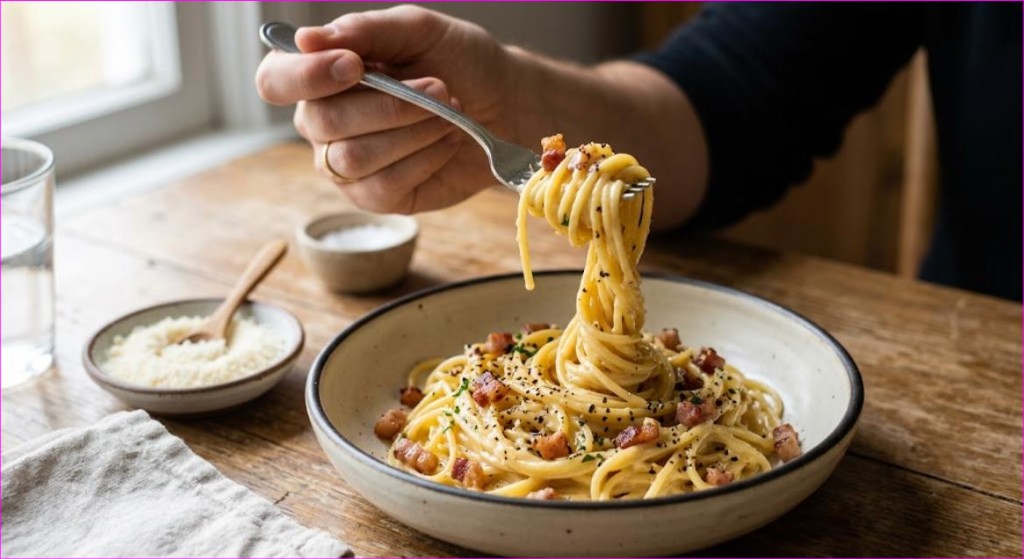
Carbonara is four ingredients and one technique. The ingredients are pasta, cured pork, egg and hard sheep’s cheese. The technique is emulsifying the egg with starchy pasta water and rendered fat at a temperature high enough to thicken the yolk but low enough that it never sets. Get that right and you have one of the great pasta dishes. Get it wrong and you have spaghetti with scrambled egg.
There is no cream in carbonara. The silkiness comes from egg yolk, cheese and emulsified fat, and adding cream is a shortcut that masks bad technique while producing a heavier, duller sauce. Once you can make it properly, the cream version tastes like a different and lesser dish.
This takes fifteen minutes of cooking and serves four. The critical moment is about ninety seconds long, and everything below is arranged so that when it arrives you are ready for it.
- Prep10 min
- Cook15 min
- Total25 min
- Serves4 servings
- CourseMain Course
- CuisineItalian
Written by Anisha Akter · Updated 24 September 2026
Why This Carbonara Recipe Works
- Egg yolks plus one whole egg gives richness without the excess white that scrambles most easily.
- The pan comes off the heat before the egg goes in, so residual warmth cooks the sauce rather than direct flame.
- Starchy pasta water is the emulsifier that binds fat and egg into a glossy sauce.
- Guanciale is rendered slowly so the fat comes out and the meat crisps rather than burns.
- Everything is tossed in the pan, not the bowl, which keeps the temperature even and the sauce moving.
Ingredients and Why They Matter
Four ingredients means there is nowhere for a poor one to hide. Here is the list and the reasoning behind each choice.
- 14 oz (400 g) spaghetti or rigatoni
- 6 oz (170 g) guanciale, cut into 1/4-inch batons
- 3 large egg yolks
- 1 whole large egg
- 1 1/4 cups (100 g) finely grated Pecorino Romano, plus more to serve
- 1 tsp freshly cracked black pepper, plus more to serve
- Salt for the pasta water
Key Ingredient Notes
Guanciale. Cured pork jowl, and the traditional choice. It has a higher fat-to-meat ratio than pancetta and a distinctive sweet, almost floral quality. Pancetta is the accepted substitute; American bacon works but brings smoke, which changes the dish considerably.
Pecorino Romano. A hard, salty sheep’s milk cheese. It is sharper than Parmesan and it is what gives carbonara its characteristic tang. Grate it very finely so it melts instantly — coarse shreds clump. A half-and-half mix with Parmigiano-Reggiano is a common and forgiving compromise.
Egg yolks plus one whole egg. Yolks carry the fat and lecithin that make the sauce creamy; whites are mostly water and protein that sets at a lower temperature, which is what causes scrambling. Three yolks to one whole egg for a pound of pasta is a reliable ratio.
Starchy pasta water. The dissolved starch acts as an emulsifier, holding the fat and egg together in suspension. This is why you salt the water but do not drown the pasta in it — less water means more concentrated starch.
Step-by-Step Instructions
- Bring a large pot of water to the boil and salt it well, but use slightly less water than usual so the starch concentrates.
- While the water heats, put the guanciale in a cold large skillet and set it over medium-low heat. Starting cold lets the fat render slowly. Cook 8 to 10 minutes, stirring occasionally, until the pieces are golden and crisp and there is a good pool of fat in the pan.
- Turn off the heat under the skillet and leave the guanciale in its fat.
- Whisk the egg yolks, whole egg, grated Pecorino and black pepper in a bowl until it forms a thick, sandy paste. It will look too dry — that is correct.
- Cook the pasta until just shy of al dente, about a minute less than the package says.
- Reserve at least 1 1/2 cups of pasta water before draining. You will use more than you expect.
- Add the drained pasta to the skillet with the guanciale and toss over low heat for 30 seconds so the pasta picks up the fat. Then turn off the heat completely.
- Add about 1/3 cup of hot pasta water to the egg and cheese mixture and whisk hard. This tempers the egg, raising its temperature gradually so it will not seize when it meets the pasta.
- Wait about 60 seconds so the pan drops below the temperature that sets egg. Pour the tempered egg mixture over the pasta and toss continuously and vigorously with tongs.
- Keep tossing and add more hot pasta water a splash at a time until the sauce turns glossy and coats each strand. This takes 60 to 90 seconds and the sauce will look thin before it suddenly comes together.
- Serve immediately in warmed bowls with more Pecorino and a heavy crack of black pepper. Carbonara does not wait.
Common Mistakes and How to Avoid Them
Adding the egg over direct heat This is the classic carbonara failure. Egg proteins set from about 150°F, and a pan that has just cooked pasta is well above that. Take the pan off the heat, wait a minute, then add the tempered egg.
Skipping the tempering step Cold egg hitting hot pasta seizes on contact. Whisking a third of a cup of hot pasta water into the egg first raises its temperature gently and gives you a far wider margin for error.
Not reserving enough pasta water The sauce needs more water than seems reasonable, and you often need to add it in two or three rounds as the sauce tightens. Reserve a cup and a half, not half a cup.
Using pre-grated cheese Pre-grated Pecorino is coated with anti-caking agents and cut too coarsely. It does not melt smoothly and leaves gritty specks. Grate it yourself on the fine side of a box grater or a microplane.
Tips for Best Results
- Warm the serving bowls. Carbonara cools fast, and cold ceramic tightens the sauce into a clump within a minute.
- If the sauce does scramble slightly, take it off the heat, add a splash more pasta water, and whisk hard. It often recovers.
- Crack the black pepper coarsely and toast it in the rendered fat for 20 seconds before the pasta goes in. It deepens the aroma considerably.
- Do not add salt to the sauce until you taste it. Between the pasta water, the guanciale and the Pecorino there is usually plenty.
- Rigatoni and bucatini both hold the sauce beautifully if spaghetti is not what you have.
Variations to Try
Carbonara with pancetta. The most common substitution outside Italy. Pancetta is leaner, so add a tablespoon of olive oil to the pan to make up the fat.
Zucchini carbonara. A summer version. Sauté thin zucchini rounds in the rendered fat until golden, then proceed as normal. It keeps the technique and lightens the dish.
Cacio e pepe adjacent. Leave out the pork entirely and use extra pasta water, cheese and pepper. It is a different dish but uses the same emulsification skill.
Half Parmigiano version. Use half Pecorino and half Parmigiano-Reggiano for a milder, nuttier sauce. Many Roman cooks do this even though purists object.
Storage, Freezing and Reheating
Carbonara is a dish to eat immediately. The sauce is an emulsion held together by heat and starch, and it breaks on cooling.
If you do have leftovers, refrigerate for up to 2 days and reheat very gently in a skillet with a splash of water, tossing constantly. Expect a noticeably heavier result.
Do not freeze carbonara. The egg sauce separates irreversibly on thawing.
What to Serve With It
Frequently Asked Questions
Does authentic carbonara have cream?
No. Traditional Roman carbonara uses only egg, cheese, cured pork, pepper and pasta water. Cream is a later addition outside Italy that makes the sauce more forgiving but heavier and less flavourful.
Why did my carbonara scramble?
The egg met heat that was too high. Turn off the burner, let the pan cool for a minute, temper the egg with hot pasta water, and toss off the heat.
Can I use bacon instead of guanciale?
You can, and plenty of people do. Bacon is smoked, which pushes the flavour in a different direction. Unsmoked pancetta is the closer substitute if you can find it.
What is the right egg ratio for carbonara?
Roughly one whole egg plus three yolks per pound of pasta, or about one yolk per person plus one whole egg for the batch. More whites means a higher risk of scrambling.
How much pasta water do I need?
Reserve at least a cup and a half. You will likely use half to three quarters of a cup, added gradually as the sauce tightens.
Can I make carbonara ahead?
Not really. The sauce is a live emulsion that breaks as it cools. You can render the guanciale and grate the cheese ahead, which leaves only five minutes of work at serving time.

Hi! I’m the creator of scooks (Simple Cooks).I share easy, practical recipes and simple cooking ideas to help you enjoy everyday home cooking with confidence.
Happy cooking! 🍽️