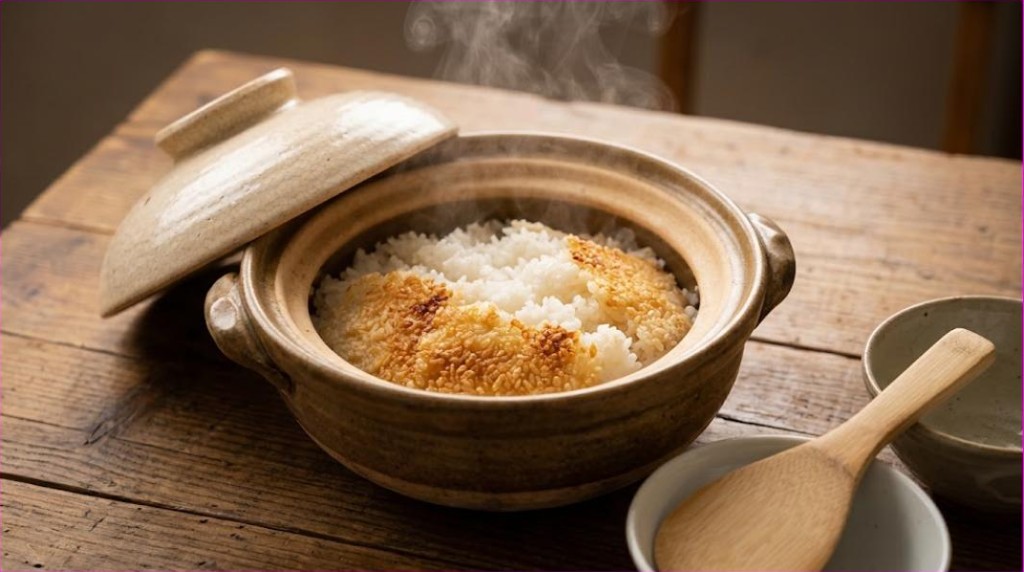
A donabe is a glazed Japanese clay pot built to sit directly over an open flame, prized for the way it holds and radiates heat evenly — perfect for rice with a crisp golden bottom (okoge) or a simmering nabemono hot pot at the table. Not all donabe are built the same way, so here’s what distinguishes the main styles.
What Actually Matters
Thermal mass is the whole point
Clay heats more slowly than metal and holds that heat far longer once it gets there. For rice, that means the pot keeps cooking gently after the flame goes off, which finishes the grains evenly and builds the prized crisp okoge layer at the base. For hot pot, it means the broth stays at a steady simmer on the table without a burner running hard underneath. A thin metal pan cannot replicate either behaviour.
Flameproof rating is not universal
This is the specification that actually matters and the one most listings bury. Traditional clay bodies can crack from thermal shock if put over a high flame from cold. Modern flameproof donabe are engineered to tolerate direct heat and quicker temperature changes. If a listing does not state a flameproof rating, assume it needs gradual heating and treat it accordingly.
The Main Styles and Who Each One Suits
Classic Rice Donabe
Purpose-built for cooking rice, with a shape and lid designed to trap steam evenly and produce a light, crisp crust on the bottom layer.
- Suits: Anyone who wants restaurant-quality rice with minimal effort.
- Key features: Domed lid for steam control, thick clay walls, typically 2-3 cup rice capacity.
Iga-yaki Clay Donabe
Made from a specific heat-resistant clay traditionally sourced from the Iga region of Japan, known for exceptional thermal shock resistance.
- Suits: Serious cooks who want the most traditional, heirloom-quality option.
- Key features: High thermal shock resistance, traditional unglazed or partially glazed exterior, long lifespan with care.
Glazed Ceramic Donabe
A more widely available, often more affordable style with a full glaze coating, easier to clean than unglazed clay but slightly less breathable.
- Suits: Everyday use and easier maintenance.
- Key features: Full interior and exterior glaze, dishwasher-safer than raw clay, wide availability.
Nabemono (Hot Pot) Donabe
A wider, shallower shape designed for tabletop hot pot dining, often served directly at the table over a portable burner.
- Suits: Sharing hot pot meals with family or guests.
- Key features: Wide shallow profile, larger capacity, table-safe stand often included.
Modern Flameproof Donabe
Engineered clay bodies rated safe for direct stovetop flame without the gradual preheating traditional donabe often require.
- Suits: Cooks who want donabe convenience without the extra care routine.
- Key features: Reinforced flameproof clay, faster heat-up, more forgiving of temperature swings.
Mini Individual Donabe
Single-serving sized pots, letting each diner cook or receive their own small portion of rice or hot pot.
- Suits: Personal-sized meals or restaurant-style individual servings at home.
- Key features: Single-serving capacity, quick heat-up time, stackable storage.
Smoked or Kamado-Style Clay Pot
A heavier-duty clay vessel built for slow smoking or extended low-heat cooking rather than quick rice or hot pot dishes.
- Suits: Cooks experimenting with clay-pot smoking and slow braises.
- Key features: Thick insulated walls, designed for extended low-heat sessions, often larger capacity.
What I Use and Why
I use a mid-sized rice donabe, and the honest surprise was how much attention it needs compared with a rice cooker. There is no automatic shut-off, so you are listening for the change in the steam sound to know when to cut the heat. Once you learn what that sounds like it becomes easy, but the first three or four attempts were guesswork and one of them was distinctly wet in the middle.
The okoge is worth the learning curve. Leaving the pot on low for the last minute or so before the rest period is what produces it, and it is the single thing that makes people ask what you did differently to the rice.
How to Choose
Before comparing specific models, it helps to narrow the field on these points:
- Whether it’s rated flameproof for direct stovetop use
- Primary purpose — rice cooking vs. hot pot vs. general simmering
- Size and how many servings it comfortably makes
- Glaze quality and ease of cleaning
- Care requirements, including seasoning before first use
New, unglazed or partially glazed donabe typically need to be seasoned before first use — usually by cooking a thin rice porridge in them — which seals fine cracks in the clay and prevents leaking. Always heat a traditional donabe gradually rather than starting on high heat, since thermal shock can crack the clay; flameproof modern versions are more forgiving here. For rice specifically, a dedicated rice donabe with a well-fitted lid outperforms a general-purpose one.
Care and Common Mistakes
Season a new unglazed or partially glazed donabe before the first proper use by simmering a thin rice porridge in it for twenty to thirty minutes. This seals the fine pores in the clay and is what prevents seepage and hairline cracking later. It is a one-time step and skipping it is the most common cause of an early failure.
Never put a hot donabe onto a cold surface or fill it with cold water while hot, and never take it from the fridge straight to a flame. Thermal shock is the main way these pots die. Let it cool on a wooden board or a folded towel, and let it come to room temperature before heating.
Dry it completely before storing. Trapped moisture in the clay leads to musty smells and, over time, mould in the pores. Air-drying upside down for several hours is the usual advice and it is worth following.
Frequently Asked Questions
Do I need to season a donabe before using it?
Yes, for traditional unglazed or partially glazed clay pots — typically by simmering a thin rice or starch porridge in it for about 20-30 minutes, which helps seal the clay’s natural pores and prevents cracking or leaking later.
Can I put a donabe directly on a gas stove?
Most donabe are designed for direct flame, but always check the manufacturer’s guidance, heat it gradually rather than starting on high, and use a diffuser if the flame is much wider than the pot’s base.
Is donabe rice really better than rice cooker rice?
Many cooks find donabe rice has better texture and a prized crispy bottom layer (okoge) that a standard rice cooker can’t replicate, though it does require more attention to timing than a fully automated cooker.

Hi! I’m the creator of scooks (Simple Cooks).I share easy, practical recipes and simple cooking ideas to help you enjoy everyday home cooking with confidence.
Happy cooking! 🍽️