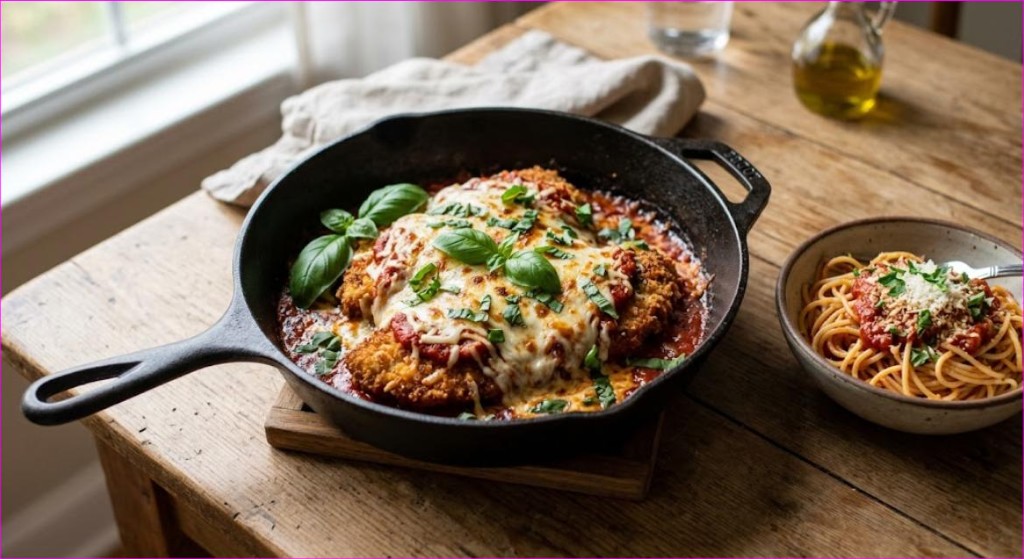
Chicken parmesan is a dish with one clear failure mode: the crust goes soft. You fry the cutlets to a perfect golden crunch, then bury them under sauce and cheese, bake for twenty minutes, and serve something that tastes good but has the texture of a wet napkin underneath.
Restaurants solve this with a technique that most home recipes skip. The sauce goes on sparingly, in the centre only, leaving a crisp border. The cheese goes directly on the chicken rather than being separated by a layer of sauce. And the dish spends five minutes under the broiler instead of twenty in the oven, so the cheese melts before the crust has time to absorb moisture.
This version takes about 50 minutes, feeds four generously, and produces cutlets with an audible crunch. Everything below — from how thin to pound the chicken to why you rest the breaded cutlets before frying — is aimed at that one goal.
- Prep25 min
- Cook25 min
- Total50 min
- Serves4 servings
- CourseMain Course
- CuisineItalian-American
Written by Anisha Akter · Updated 23 September 2026
Why This Chicken Parmesan Recipe Works
- The chicken is pounded to an even 1/2 inch, so it cooks through in the time the crust takes to brown.
- A three-stage breading with panko gives more crunch and better adhesion than flour and breadcrumbs alone.
- Breaded cutlets rest for 10 minutes before frying, which glues the coating to the meat so it does not slide off.
- Sauce is applied to the centre only, keeping the edges crisp.
- The broiler finishes the dish in five minutes instead of the twenty that turns a crust soft.
Ingredients and Why They Matter
Panko is not optional if you want real crunch — it stays crisp far longer than fine dried breadcrumbs. Notes on the other decisions follow.
- 2 large boneless skinless chicken breasts (about 1 1/2 lb / 680 g)
- 1/2 cup (60 g) all-purpose flour
- 2 large eggs
- 1 tbsp water
- 1 1/2 cups (90 g) panko breadcrumbs
- 1/2 cup (50 g) finely grated Parmesan, plus more to finish
- 1 tsp garlic powder
- 1 tsp dried oregano
- Salt and freshly ground black pepper
- 1/2 cup (120 ml) neutral oil, for frying
- 1 1/2 cups (360 ml) marinara sauce, warmed
- 6 oz (170 g) low-moisture mozzarella, sliced or shredded
- Fresh basil leaves, torn
- Spaghetti or a green salad, to serve
Key Ingredient Notes
Panko breadcrumbs. Panko is made from crustless bread dried into large flaky shards. Those shards trap air, which is why panko crusts crunch instead of crumbling, and why they resist sogginess better than fine breadcrumbs.
Low-moisture mozzarella. Fresh mozzarella in water tastes better on its own but releases a startling amount of liquid when melted, which floods the crust. Low-moisture block mozzarella melts cleanly. Grate it yourself; pre-shredded cheese carries anti-caking starch that makes it grainy.
Parmesan in the breading. Mixing grated Parmesan into the panko seasons the crust from within and adds savoury depth that surface cheese alone cannot reach. Use finely grated real Parmesan, not the powdered kind.
Chicken breast, split horizontally. Two large breasts split into four thin cutlets is better than four small breasts. Splitting gives you even thickness, which is what stops the outside burning before the inside is done.
Step-by-Step Instructions
- Place each chicken breast flat on a board and slice it horizontally into two thin cutlets. Cover with plastic wrap and pound gently with a mallet or heavy pan until an even 1/2 inch thick. Season both sides with salt and pepper.
- Set up three shallow dishes: flour in the first; eggs beaten with water in the second; panko mixed with Parmesan, garlic powder, oregano and a good pinch of salt in the third.
- Coat each cutlet in flour and shake off the excess, then dip in egg and let the excess drip off, then press firmly into the panko mixture on both sides. Pressing matters — the crumbs need contact to stick.
- Lay the breaded cutlets on a wire rack and rest for 10 minutes. This lets the coating hydrate and bond to the chicken so it does not slide off in the pan.
- Heat the oil in a large skillet over medium-high until a crumb dropped in sizzles immediately. The oil should be about 1/4 inch deep.
- Fry two cutlets at a time for 3 to 4 minutes per side, until deep golden. Do not move them during the first three minutes. Transfer to a clean wire rack, not paper towels — paper traps steam and softens the underside.
- Set the oven to broil with a rack about 6 inches from the element.
- Arrange the fried cutlets on a baking sheet. Spoon 2 to 3 tablespoons of warm marinara over the centre of each, leaving a half-inch crisp border all the way around. Do not flood them.
- Top with mozzarella and a little extra Parmesan, keeping the cheese within the sauce area.
- Broil for 3 to 5 minutes, watching constantly, until the cheese is melted with browned blisters. Finish with torn basil and serve at once with extra warm sauce on the side.
Common Mistakes and How to Avoid Them
Drowning the cutlets in sauce A generous ladle of marinara over the whole cutlet guarantees a soft crust. Sauce the centre only and serve the rest at the table. This single change is the biggest improvement most people can make.
Skipping the rest after breading Freshly breaded chicken sheds its coating in hot oil. Ten minutes on a rack lets the egg set against the flour and the panko, and the crust stays put.
Uneven thickness A cutlet that is an inch thick at one end and a quarter inch at the other cannot cook evenly. The thin end burns while the thick end stays raw. Pound it flat — it takes two minutes.
Draining on paper towels Steam rising off the hot cutlet condenses against the paper and softens the bottom crust. A wire rack lets air circulate underneath and keeps both sides crisp.
Tips for Best Results
- Use one hand for the dry dishes and one for the egg. It stops your fingers turning into breaded clubs halfway through.
- Keep the fried cutlets warm in a 200°F oven on a rack while you fry the rest, so all four go under the broiler together.
- If the panko browns before the chicken is cooked, the oil is too hot. Drop the heat to medium and give it a minute to settle.
- A pinch of red pepper flakes in the breading adds a background warmth that most people notice but cannot identify.
- Warm the marinara before it goes on. Cold sauce cools the cutlet and slows the cheese melting, which means more time under the broiler and a softer crust.
Variations to Try
Eggplant parmesan. Swap the chicken for 1/2-inch slices of eggplant, salted for 30 minutes and patted dry. The breading and finishing method are identical.
Chicken parm sandwich. Tuck a finished cutlet into a toasted ciabatta roll with extra sauce and basil. Toast the bread well so it stands up to the sauce.
Baked, not fried. Spray the breaded cutlets generously with oil and bake on a wire rack at 425°F for 20 minutes, flipping once. Less crisp than frying but considerably lighter.
Air fryer chicken parmesan. Cook the breaded cutlets at 380°F for 12 minutes, flipping halfway, then add sauce and cheese and cook 3 minutes more.
Storage, Freezing and Reheating
Refrigerate leftovers up to 3 days. The crust will soften in the fridge, which is unavoidable once sauce is on.
Reheat on a wire rack in a 400°F oven for 12 to 15 minutes. This drives off moisture and brings back much of the crunch. The microwave will not.
Freeze breaded, unfried cutlets in a single layer for up to 3 months. Fry from frozen, adding 2 minutes per side. This is the best make-ahead route.
What to Serve With It
Frequently Asked Questions
Why does my breading fall off?
Three usual causes: the chicken was wet before flouring, the coating was not pressed on firmly, or the cutlets went straight into the pan. Pat the chicken dry, press the panko on hard, and rest the breaded cutlets 10 minutes before frying.
How do I keep chicken parmesan crispy?
Sauce the centre only, put the cheese directly on the chicken, and finish under the broiler for five minutes instead of baking for twenty. Drain on a wire rack, never paper towels.
Can I make chicken parmesan ahead?
Bread the cutlets up to a day ahead and keep them on a rack in the fridge, uncovered. Fry and finish just before serving. Fully assembled parm does not hold well.
Fresh or low-moisture mozzarella?
Low-moisture for this dish. Fresh mozzarella releases water as it melts and will soak the crust. If you prefer the flavour of fresh, slice it and blot it dry on paper towels first.
What sauce should I use?
A simple marinara — tomatoes, garlic, olive oil, basil. Heavy, chunky or sweet sauces overwhelm the chicken. Whatever you use, warm it first.
Can I use chicken thighs?
Yes. Boneless thighs pound out well and stay juicier, though they are harder to get into an even shape. Cook them a minute longer per side.

Hi! I’m the creator of scooks (Simple Cooks).I share easy, practical recipes and simple cooking ideas to help you enjoy everyday home cooking with confidence.
Happy cooking! 🍽️