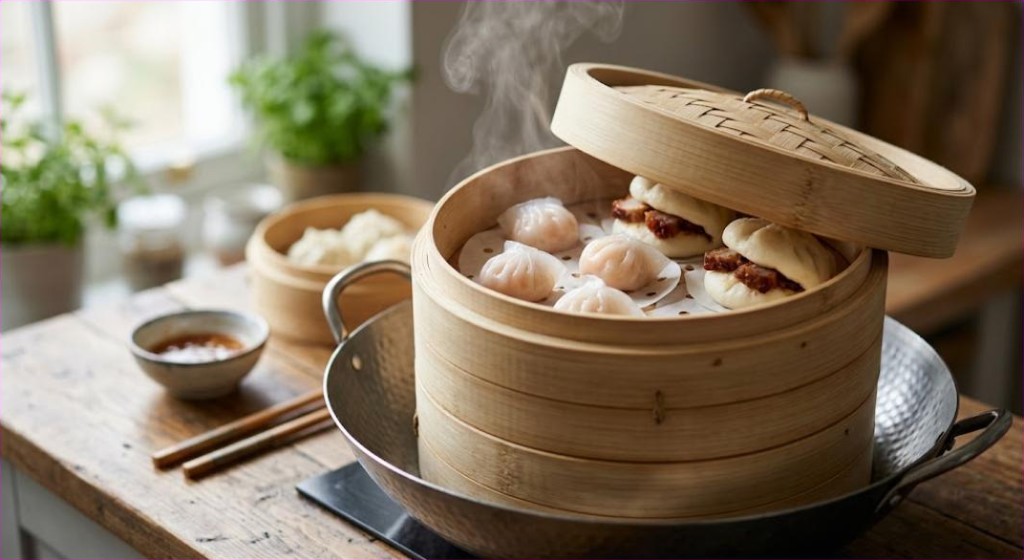
Bamboo steamers do one thing extremely well: they let steam circulate evenly around food while the woven lid absorbs excess condensation, so dumplings and buns come out without the soggy bottoms you often get from metal steamer inserts. Picking the right size and configuration depends mostly on how much you’re cooking at once and what wok or pot you already own.
What Actually Matters
Condensation is the real difference
The practical advantage of bamboo over a metal steamer has nothing to do with heat and everything to do with water. A metal lid is impermeable, so steam condenses on the underside and drips straight back onto the food, which is why dumplings from a metal steamer often have wet, collapsed tops. A woven bamboo lid absorbs a good part of that condensation instead. That single property is why dim sum restaurants use bamboo.
Diameter has to match your wok or pot
A bamboo steamer is designed to sit inside the sloping walls of a wok, resting against them rather than balancing on a rim. Too small and it drops in and tips; too large and it perches unstably and lets steam escape around the edge. Measure the internal diameter of the pan you intend to use before buying, because this is the mistake that makes a steamer unusable rather than merely imperfect.
The Main Styles and Who Each One Suits
Traditional 2-Tier Bamboo Steamer
The standard configuration for home cooks, letting you steam two dishes at once, such as dumplings on one tier and vegetables on another.
- Suits: Everyday steaming for a small household.
- Key features: Two stacked tiers, woven lid, typically 10-12 inch diameter.
Single-Tier Bamboo Steamer
A simpler, smaller option for occasional use or steaming just one dish at a time.
- Suits: Small kitchens or infrequent steamers who don’t need multi-tier capacity.
- Key features: One tier, compact storage, lower cost entry point.
Bamboo Steamer with Silicone Liners
Comes bundled with reusable silicone mats that prevent food from sticking to the bamboo slats without needing parchment or cabbage leaves.
- Suits: Cooks who want easier cleanup without disposable liners.
- Key features: Included silicone liners, reusable and dishwasher-safe liners, standard bamboo tiers.
Large Family-Size Bamboo Steamer
A wider-diameter steamer built to handle bigger batches, useful for entertaining or meal-prepping large quantities of dumplings at once.
- Suits: Big families or hosting dim sum-style gatherings.
- Key features: 14+ inch diameter, higher food capacity per tier, requires a correspondingly large wok.
Stackable Multi-Tier Set (3+ tiers)
Extends the standard two-tier format to three or more layers, maximizing the amount you can steam simultaneously from a single heat source.
- Suits: Cooking several different dishes at once for a bigger meal.
- Key features: 3+ stacked tiers, shared woven lid, tallest stack requires more careful balance on the wok.
Bamboo Steamer and Wok Combo
Sold as a matched set with a wok specifically sized to support the steamer basket snugly, removing the guesswork of pairing sizes yourself.
- Suits: First-time buyers who don’t already own a compatible wok.
- Key features: Matched wok and steamer sizing, often includes a lid for the wok itself, good starter set.
Mini Dim Sum Steamer
A small-format steamer, often around 6-8 inches, sized for individual servings or as a decorative table-side presentation piece.
- Suits: Restaurant-style individual portions or small-batch steaming.
- Key features: Compact 6-8 inch size, quick steam time, doubles as a serving vessel.
What I Use and Why
I keep a two-tier ten-inch bamboo steamer and use it far more for vegetables than for dumplings, which was not the plan when I bought it. Green beans and broccoli come out better than in a metal basket, again because nothing drips onto them.
The liner question took me a while to settle. Parchment rounds work but you get through a lot of them. Cabbage or lettuce leaves are traditional, free, and add nothing bad to the flavour. I now use cabbage leaves for anything savoury and keep perforated parchment for sticky buns.
How to Choose
Before comparing specific models, it helps to narrow the field on these points:
- Diameter — must match or slightly exceed your wok or pot
- Number of tiers for cooking multiple dishes at once
- Bamboo quality and weave tightness
- Included liners or need to buy separately
- Ease of cleaning and drying to prevent mold
Measure your wok or pot’s diameter before buying — a bamboo steamer should sit snugly inside the rim, not perched precariously on top. Season a new bamboo steamer by rinsing it well and letting it dry fully before first use, and always dry it thoroughly after washing to prevent mold, since bamboo is porous. Liners (parchment, cabbage leaves, or silicone mats) are worth using every time to keep the slats clean and food from sticking.
Care and Common Mistakes
Do not use soap and never put bamboo in a dishwasher. Bamboo is porous and will absorb detergent, which then transfers to food. Hot water and a stiff brush is the correct method, followed by thorough air-drying.
Mould is the main way bamboo steamers are ruined, and it comes almost entirely from storing them damp. Stand the tiers apart with airflow around them until they are bone dry, and store them somewhere ventilated rather than sealed in a cupboard immediately after use.
Always use a liner. Unlined, food sticks to the slats and the residue is difficult to remove without soap, which brings you back to the first problem.
Related Reading
Frequently Asked Questions
How do I clean a bamboo steamer without it molding?
Rinse with warm water and a soft brush rather than soap, which bamboo can absorb, then dry it completely — ideally standing upright with airflow — before storing. Never put it in the dishwasher.
Do I need to season a bamboo steamer before first use?
A light rinse and full air-dry before the first use is usually enough; some cooks also do a first steam run with just water to remove any manufacturing residue and a raw bamboo smell.
What size bamboo steamer should I buy?
Match it closely to your wok or pot’s inner diameter — a steamer that’s too small will tip, and one that’s too large won’t seat properly and will leak steam around the edges.

Hi! I’m the creator of scooks (Simple Cooks).I share easy, practical recipes and simple cooking ideas to help you enjoy everyday home cooking with confidence.
Happy cooking! 🍽️