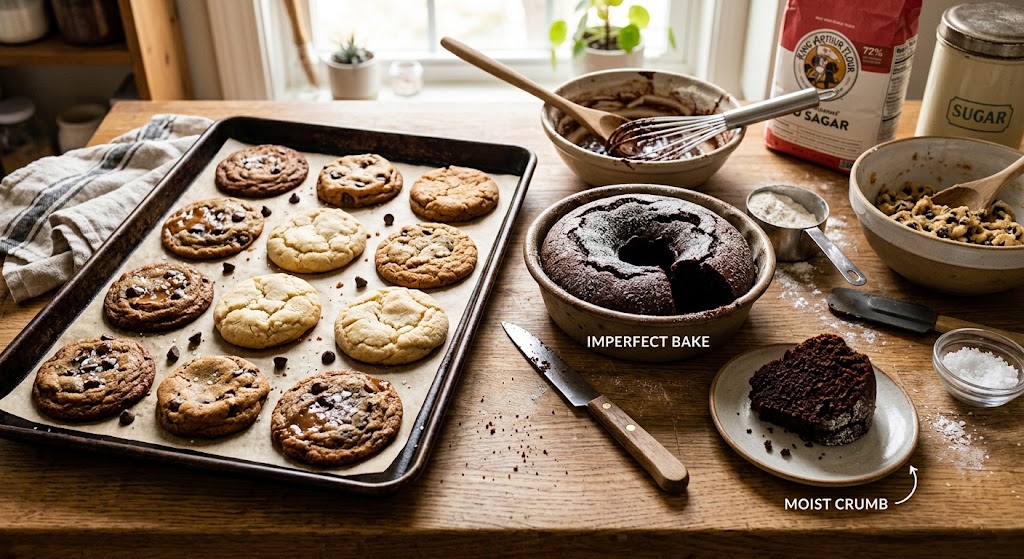
Short answer: Cookies are flat because the butter is too soft or melted, the dough is over-mixed, or the baking temperature is too low. These factors cause the dough to spread excessively during baking, preventing proper structure formation and resulting in flat cookies.
Cookies and cakes can fail in many ways: cookies can spread too thin or become hard or cakey, while cakes can be dry, dense, or sink in the middle. These problems usually arise from ingredient ratios, mixing methods, oven temperature, or baking times.
This page explains the most common causes behind flat cookies, hard cookies, cakey cookies, dry cakes, sunken cakes, and dense cakes. It provides clear explanations and practical tips for home bakers to diagnose and fix these issues quickly.
Written by Anisha Akter · Updated 13 September 2026
On this page
Why are my cookies flat
Cookies are flat because the butter is too soft or melted, the dough is over-mixed, or the baking temperature is too low.
Butter is a key fat that solidifies during baking to help cookies hold their shape. When butter is melted or very soft—above about 20°C (68°F)—it spreads quickly under heat before proteins and starches can set the structure. Over-mixing dough develops gluten networks from the flour, which can relax and cause excessive spreading. Additionally, baking at temperatures below 175°C (350°F) delays the setting of the dough’s proteins and starches, allowing the cookie to spread too thin before firming up.
Use butter chilled or just softened to about 18-20°C (65-68°F), mix dough only until ingredients combine, and bake on a preheated tray at 175-190°C (350-375°F) to control spread and shape.
Why are my cookies hard
Cookies turn hard when overbaked, have too much sugar or flour, or use cold butter that doesn’t spread properly.
Hardness in cookies results from moisture loss and excessive gluten development. Baking cookies too long or at temperatures above 190°C (375°F) causes water to evaporate excessively, drying out the cookie. High sugar content can crystallize upon cooling, creating a crunchy, hard texture. Using cold butter reduces dough spread, leading to thicker cookies that bake longer, which can harden them. Overmixing increases gluten formation, making the cookie’s structure tougher rather than tender.
Bake cookies just until the edges are golden and centers still look slightly soft, measure sugar and flour accurately, and use softened butter for proper spread and texture.
Why are my cookies cakey
Cookies become cakey when the dough has too much liquid or flour, or when baking powder or soda is overused.
A cakey texture arises from a higher ratio of liquid and leavening agents that introduce air bubbles into the dough. Excess liquid hydrates more flour proteins, creating a soft, sponge-like crumb. Overusing baking powder or baking soda produces excess carbon dioxide gas, which expands the dough and creates a puffier, softer cookie. Additional eggs add moisture and protein, further contributing to cakeyness. Overmixing incorporates extra air, enhancing this effect by increasing volume and tenderness.
Follow recipe ratios precisely, use leavening agents within recommended amounts, and mix dough only until ingredients are just combined to avoid excess aeration and cakey texture.
Why is my cake dry
Cake is dry when overbaked, contains too much flour or sugar, or lacks enough fat or liquid.
Dry cakes result from moisture loss and ingredient imbalances. Overbaking causes water to evaporate beyond the ideal level, leaving crumb dry and crumbly. Too much flour absorbs moisture, especially if packed tightly during measuring, reducing available water in the batter. Excess sugar draws moisture out over time through hygroscopic effects, drying the cake’s surface and interior. Insufficient fat reduces tenderness and moisture retention, as fats coat flour proteins and slow moisture loss. Low liquid content reduces steam formation during baking, which helps keep cakes moist.
Measure flour using spoon-and-level methods, avoid overbaking by checking doneness early, and ensure fat and liquid quantities meet recipe specifications for moist, tender cakes.
Why did my cake sink in the middle
A cake sinks because it was underbaked, had too much leavening, or was removed from the oven too soon.
Sinking occurs when the cake’s structure hasn’t fully set before cooling. Leavening agents like baking powder or soda release carbon dioxide rapidly; if the cake cools prematurely or the oven temperature is too low, gas bubbles collapse, causing the center to sink. Underbaking leaves excess moisture and a weak crumb unable to support the cake’s weight. Opening the oven door early causes temperature drops, halting baking and destabilizing the structure. Excess sugar can also weaken the crumb, contributing to sinking by preventing proper protein coagulation.
Bake until a toothpick inserted near the center comes out clean, avoid opening the oven door during baking, and measure leavening agents carefully to prevent excess gas production.
Why is my cake dense
Cakes are dense when mixed too much, have too little leavening, or contain heavy ingredients without enough aeration.
Density arises from tight gluten networks and insufficient gas bubbles. Overmixing batter develops gluten strands, making the crumb firm and compact rather than light and airy. Using too little baking powder or baking soda reduces carbon dioxide production, limiting rise and leaving a heavy texture. Incorporating heavy ingredients like nuts, dried fruit, or whole grains increases batter weight; without adequate leavening or gentle folding, this leads to dense cakes. Baking too slowly or at low temperature can cause heavier batters to settle before setting, compounding density.
Mix batter only until combined, measure leavening agents precisely, fold in heavy ingredients gently, and bake at the correct temperature for proper rise and texture.
How to avoid common cookie and cake baking problems
- Use room temperature butter, not melted, for cookie dough to control spread.
- Measure flour by spooning into the cup and leveling, never scooping directly from the bag.
- Preheat the oven fully to the correct temperature before baking.
- Avoid overmixing batters and doughs to prevent tough textures and density.
- Check cakes with a toothpick near the end of baking to avoid dryness or sinking.
- Use correct amounts of baking powder or soda to ensure proper rise without collapse.
Recipes that use this
Frequently Asked Questions
Can chilling cookie dough help prevent flat cookies?
Yes, chilling cookie dough solidifies the butter, slowing the spread during baking and resulting in thicker, less flat cookies. The cold fat melts more slowly in the oven, allowing the dough structure to set before it spreads. Chilling for 30 minutes to an hour is usually sufficient to firm the dough and improve texture.
Why does adding too much flour make cookies hard?
Adding too much flour increases the amount of dry, absorbent material in the dough, which soaks up moisture and makes the final cookie drier. Excess flour also encourages more gluten development when mixed, resulting in a tougher, harder texture after baking. Measuring flour by spooning and leveling, rather than scooping, helps avoid using too much flour.
How does oven temperature affect cake texture?
Oven temperature controls how quickly cakes set and rise. Baking at too low a temperature delays protein coagulation and starch gelatinization, causing cakes to sink or become dense because the structure isn’t stable when gases expand. Too high a temperature dries the cake out or causes the crust to burn before the inside is cooked. Precise temperature control ensures the cake rises properly and retains moisture.

Hi! I’m the creator of scooks (Simple Cooks).I share easy, practical recipes and simple cooking ideas to help you enjoy everyday home cooking with confidence.
Happy cooking! 🍽️