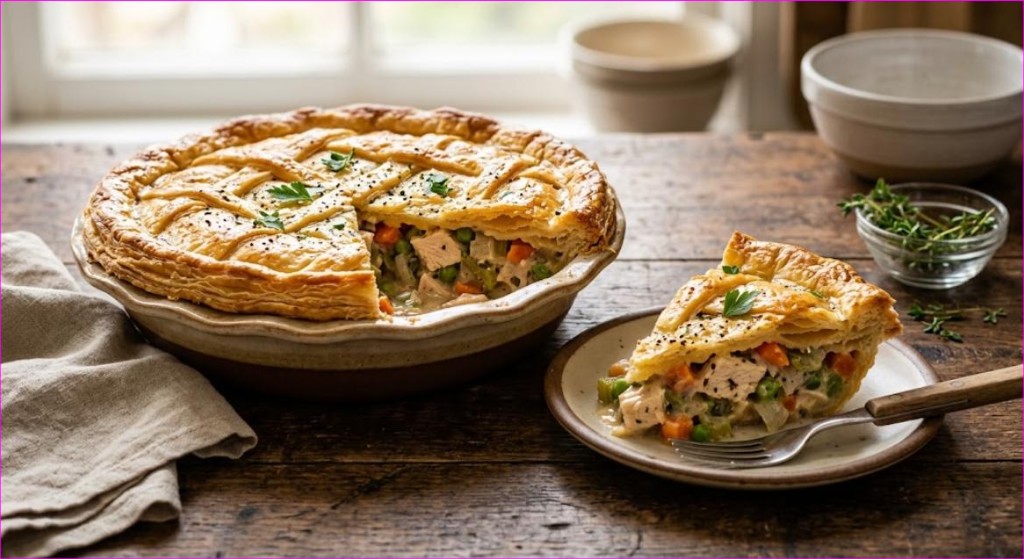
A chicken pot pie is judged on two things: whether the filling holds together when you cut into it, and whether the pastry underneath is crisp or sodden. Everything else — which vegetables, which herbs, whether you use a top crust only or a full double crust — is preference. Those two structural questions are where recipes succeed or fail.
Both problems come from moisture. Chicken and vegetables release water as they cook, and if the sauce is not thick enough to absorb it, you end up with soup under a lid. A bottom crust sitting in that liquid never has a chance to crisp. The fixes are simple once you know them, and they are built into the method below.
This recipe makes a generous six-serving pie in a 9-inch deep dish, takes about 75 minutes of active and oven time, and uses a from-scratch velouté that you can make while the oven preheats. You can use store-bought pastry without apology — the filling is where this dish earns its reputation.
- Prep30 min
- Cook45 min
- Total1 hr 15 min
- Serves6 servings
- CourseMain Course
- CuisineAmerican
Written by Anisha Akter · Updated 22 September 2026
Why This Chicken Pot Pie Recipe Works
- The sauce is deliberately thicker than seems right, because the chicken and vegetables thin it as the pie bakes.
- Vegetables are cooked before they go in the pie, so they release their water into the pan rather than into the crust.
- The bottom crust is blind-baked, which is the only reliable way to keep it crisp under a wet filling.
- An egg wash on the top crust gives the deep golden colour that makes a pot pie look like it came from a bakery.
- The filling can be made a day ahead, which turns this into a realistic weeknight dinner.
Ingredients and Why They Matter
This makes one 9-inch deep-dish pie with a top and bottom crust. Notes on the ingredients that most affect the outcome follow the list.
- 2 pie crusts (homemade or store-bought, chilled)
- 1 1/2 lb (680 g) boneless skinless chicken thighs or breast, cut into 3/4-inch pieces
- 4 tbsp (55 g) unsalted butter
- 1 medium onion, diced
- 2 carrots, diced small
- 2 celery stalks, diced small
- 8 oz (225 g) cremini mushrooms, quartered (optional)
- 1/3 cup (40 g) all-purpose flour
- 2 1/2 cups (600 ml) chicken stock, warm
- 1/2 cup (120 ml) whole milk or heavy cream
- 1 cup (140 g) frozen peas
- 1 tsp fresh thyme leaves
- 1 tsp poultry seasoning or dried sage
- 1 tbsp lemon juice
- Salt and freshly ground black pepper
- 1 egg beaten with 1 tbsp water, for the wash
Key Ingredient Notes
Chicken thighs. Thighs stay juicy through a 45-minute bake in a way breast meat does not. If you use breast, cut the pieces slightly larger and add them to the sauce raw so they poach gently rather than overcook twice.
Warm chicken stock. Cold stock hitting a hot roux causes lumps. Warming it in the microwave for 90 seconds means the sauce comes together smoothly with minimal whisking.
Frozen peas, added last. Peas are already cooked when frozen. Stirring them in at the end keeps them bright green and sweet instead of grey and mushy.
Lemon juice. A single tablespoon at the end is not enough to taste as lemon, but it is enough to stop a cream-and-butter filling from tasting heavy. Skip it and the pie tastes flat by the third bite.
Step-by-Step Instructions
- Heat the oven to 400°F (200°C). Roll one pie crust into a 9-inch deep pie dish, press it in, trim the overhang to 1/2 inch, and prick the base all over with a fork.
- Line the crust with parchment, fill with pie weights or dried beans, and blind-bake for 15 minutes. Remove the weights and parchment and bake 5 minutes more until the base looks dry and pale gold. Set aside to cool. This step is what keeps the bottom crisp.
- While the crust bakes, melt the butter in a large skillet over medium heat. Add the onion, carrots and celery with a good pinch of salt and cook 8 minutes until softened but not browned.
- If using mushrooms, raise the heat to medium-high, add them, and cook 5 minutes until their liquid has evaporated and they start to colour. Getting that water out now is what stops a watery pie later.
- Add the chicken pieces and cook 4 to 5 minutes, stirring, until they are opaque on the outside. They do not need to be cooked through.
- Sprinkle the flour over everything and stir constantly for 90 seconds to cook out the raw taste.
- Pour in the warm stock in three additions, stirring smooth after each. Add the milk, thyme and poultry seasoning. Simmer 5 to 7 minutes, stirring often, until the sauce is thick enough that a spoon dragged through it leaves a track that holds for a second.
- Stir in the frozen peas and the lemon juice. Taste and season assertively with salt and pepper — the pastry will mute the seasoning. Let the filling cool for 15 minutes; hot filling will melt the top crust before it bakes.
- Pour the filling into the blind-baked shell. Lay the second crust over the top, trim, crimp the edges together, and cut four generous steam vents in the centre.
- Brush the top with egg wash and bake at 400°F for 35 to 45 minutes, until the crust is deep golden and you can see the filling bubbling through the vents.
- Rest the pie for 15 minutes before cutting. This is not optional — the filling continues to set as it cools, and cutting early gives you a runny slice.
Common Mistakes and How to Avoid Them
Filling that is too thin going into the pie The filling should look almost too thick in the pan — nearly like a stew rather than a sauce. Chicken and vegetables release more liquid during baking, and a sauce that looks correct in the skillet will be soup in the dish.
Skipping the blind bake A raw bottom crust under a wet filling steams rather than bakes. Twenty minutes of blind baking is the difference between pastry and paste. If you are short on time, make it a top-crust-only pie instead.
Pouring hot filling into the crust Hot filling starts melting the butter in the top crust before it reaches the oven, which destroys the flaky layers. Fifteen minutes of cooling solves it.
Cutting the pie straight out of the oven The filling is at its thinnest when it is hottest. A 15-minute rest lets the starches set so the slice holds its shape on the plate.
Tips for Best Results
- Cook the filling in a wide skillet rather than a saucepan. More surface area means faster evaporation and a thicker sauce in less time.
- A rotisserie chicken turns this into a 40-minute recipe. Skip the raw chicken step and stir 3 cups of shredded meat in with the peas.
- If your top crust browns before the filling bubbles, tent it loosely with foil and keep baking.
- Place the pie dish on a preheated baking sheet. The extra bottom heat helps the base crust along and catches any drips.
- Season the filling more than feels right. Pastry absorbs salt, and an under-seasoned pot pie is the most common disappointment.
Variations to Try
Turkey pot pie. The classic use for leftover roast turkey. Swap it in one-for-one with cooked chicken and add a little extra stock, since roast turkey is drier.
Biscuit-topped pot pie. Skip the pastry entirely, pour the filling into a baking dish, and drop rounds of biscuit dough on top. Bake 20 to 25 minutes until the biscuits are golden and cooked through.
Vegetable pot pie. Replace the chicken with a mix of potato, parsnip and butternut squash, use vegetable stock, and add a teaspoon of white miso for savoury depth.
Individual pot pies. Divide the filling among four ramekins and top each with a pastry round. Bake at 400°F for 25 minutes. These freeze and reheat far better than a full pie.
Storage, Freezing and Reheating
Refrigerate covered for up to 4 days. Reheat slices in a 350°F oven for 20 minutes rather than the microwave, which turns the pastry rubbery.
Freeze an unbaked assembled pie for up to 3 months. Bake from frozen at 375°F for 60 to 75 minutes, covering the top with foil for the first 40 minutes.
The filling alone keeps 3 days in the fridge and 3 months in the freezer, which makes assembling a fresh pie on a weeknight straightforward.
What to Serve With It
Frequently Asked Questions
Why is my chicken pot pie watery?
Either the sauce was not thick enough before baking, or the vegetables went in raw. Cook the vegetables first so they release their water into the skillet, and simmer the sauce until a spoon leaves a visible track through it.
Do I need a bottom crust?
No. Many cooks make top-crust-only pot pies precisely to avoid the soggy-bottom problem, and the result is just as good. If you do want a bottom crust, blind-bake it.
Can I use puff pastry for the top?
Yes, and it gives a dramatic result. Bake at 400°F and watch it closely from the 25-minute mark, since puff pastry browns faster than shortcrust.
Can I make chicken pot pie ahead?
Assemble the whole pie, refrigerate it unbaked for up to 24 hours, then bake as directed adding 10 minutes. Do not assemble more than a day ahead or the bottom crust softens.
What vegetables work best in pot pie?
Carrot, celery, onion and peas are the standard. Mushrooms, corn, green beans and diced potato all work. Avoid high-water vegetables like zucchini and tomato, which thin the filling.
How do I stop the crust edges burning?
Cover just the rim with strips of foil or a pie shield for the first 25 minutes, then uncover so the edges catch up with the centre.

Hi! I’m the creator of scooks (Simple Cooks).I share easy, practical recipes and simple cooking ideas to help you enjoy everyday home cooking with confidence.
Happy cooking! 🍽️