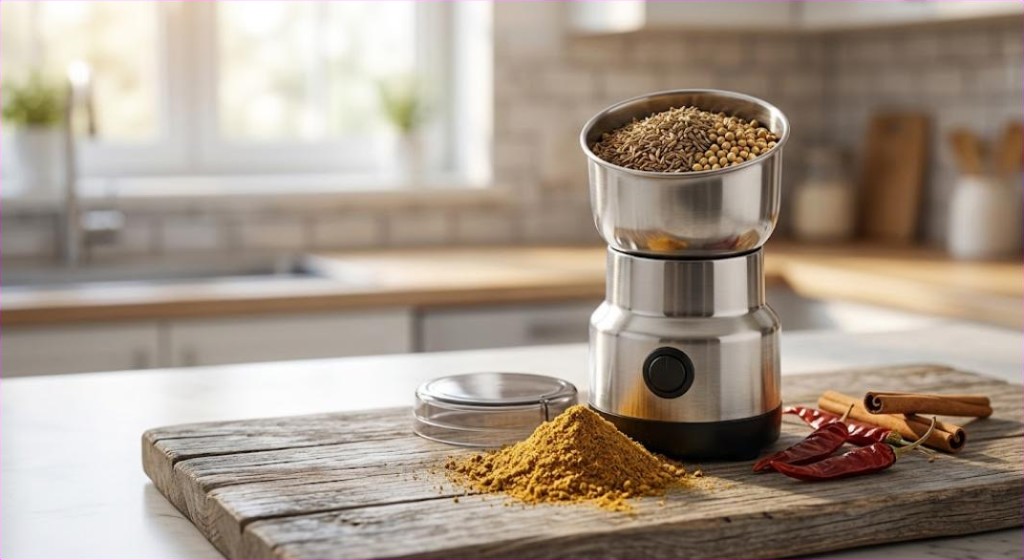
Whole spices hold their aroma for months; ground spices start losing it within weeks of being milled. That gap is the entire argument for grinding your own, and it is large enough to be obvious in the finished dish. The question is only which tool makes the habit easy enough that you actually keep it up.
The honest answer for most kitchens is that you need less than the market suggests. A modest electric grinder and a mortar and pestle between them cover almost everything, and the more expensive options solve narrower problems.
What Actually Matters
Blade versus burr changes consistency, not speed
A blade grinder chops spices by hitting them repeatedly, so you get a mixture of fine powder and larger fragments, and the result depends on how long you run it. A burr grinder mills between two surfaces set at a fixed gap, so particle size is uniform and repeatable. For most home cooking the unevenness of a blade grinder is invisible in the finished dish; it matters most when you want a very fine, uniform powder for a delicate spice blend.
Heat is the hidden variable
Grinding generates heat, and heat drives off the volatile aromatic compounds you are grinding to capture in the first place. Running a blade grinder continuously for a minute warms the spice noticeably. Pulsing in short bursts, and grinding in small batches rather than filling the bowl, preserves substantially more aroma than one long grind.
Flavour carryover is a practical constraint
Turmeric stains, asafoetida is persistent, and coffee oils cling to everything. Plastic bowls absorb all three; stainless steel does not. If a single grinder has to do everything, the material of the bowl is the specification that decides how much of last week’s spice ends up in this week’s.
The Main Types and Who Each One Suits
Electric Blade Grinder (Coffee/Spice Type)
A small motorised blade grinder, the most common and affordable route into grinding your own spices. It chops rather than mills, so the grind is slightly uneven, but for most home cooking that is not a limitation.
- Suits: Occasional grinding without buying dedicated equipment.
- Key features: Blade action, compact, low cost, easy to find.
Dedicated Stainless Steel Spice Grinder
A grinder built for spices, usually with a stainless steel bowl rather than plastic, which resists staining and does not retain the smell of turmeric or cumin between uses.
- Suits: Regular spice grinding without tainting a coffee grinder.
- Key features: Steel bowl, spice-specific design, wipes clean easily.
Mortar and Pestle
Entirely manual, and still the best tool for small quantities, coarse textures and wet pastes such as ginger-garlic or a fresh curry paste, which no dry grinder handles well.
- Suits: Small amounts, coarse grinds and pastes.
- Key features: Stone or granite, no power required, full control over texture.
Manual Hand-Crank Spice Mill
A crank-operated mill along the lines of a pepper grinder but built for a wider range of seeds and pods, often with an adjustable coarseness setting.
- Suits: Grinding one spice fresh at the point of use.
- Key features: Crank mechanism, adjustable grind on many models, no electricity.
Blade Grinder with Interchangeable Jars
A single motor base with several detachable jars, so coffee and spices never share a chamber and strong spices can be kept apart from mild ones.
- Suits: Households grinding both coffee and spices.
- Key features: Multiple jars, one base, avoids flavour crossover.
Burr Grinder
Mills between two abrasive surfaces rather than chopping, giving a far more uniform particle size. More common for coffee, but worth knowing about for anyone who wants genuinely consistent powder.
- Suits: Cooks who want a uniform, repeatable grind.
- Key features: Burr mechanism, consistent particle size, higher cost.
Compact Manual Travel Grinder
A small hand grinder for travel or very limited storage, trading capacity and speed for portability.
- Suits: Travel and small kitchens.
- Key features: Pocket-sized, manual, minimal cleaning.
What I Use and Why
I keep a cheap stainless steel blade grinder for dry spices and a granite mortar for everything wet or coarse, and that pairing has not needed supplementing. The mortar gets used more often than I expected, mostly for crushing a few cardamom pods or garlic where getting out an appliance is more effort than the job deserves.
The thing that improved my results most was grinding smaller amounts more often. I used to grind a jar’s worth of garam masala at a time and it was noticeably duller by the end of it. A few tablespoons every couple of weeks tastes better and takes no more total effort.
How to Choose
Before comparing specific models, it helps to narrow the field on these points:
- Whether it will be shared with coffee, and how you will keep flavours separate
- Bowl material, since stainless steel resists staining and odour retention far better than plastic
- Typical batch size, from a pinch of pepper to a jar of homemade blend
- How easily it comes apart for cleaning
- Noise, if you grind early in the morning
For most people a dedicated stainless steel blade grinder plus a stone mortar and pestle covers the full range, because they fail in opposite directions: the grinder handles hard, dry seeds in quantity, while the mortar handles small amounts, wet pastes and anything you want coarse rather than powdered. Burr grinders produce a more uniform result and are worth it if consistency genuinely matters to you, but they are a refinement rather than a starting point.
Care and Common Mistakes
Grind in short pulses rather than one long run. It keeps the spice cooler, and cooler spice keeps more of its aroma.
Clean between strongly flavoured spices with a rice grind and a dry wipe rather than water, since most blade grinder housings are not designed to be immersed.
Store whole spices away from heat and light and grind as needed. No grinder compensates for stale whole spice, and a well-kept jar of whole cumin will outlast several jars of pre-ground.
Frequently Asked Questions
Can I use my coffee grinder for spices?
You can, but the flavours carry over in both directions and coffee oils are persistent. If you only have one grinder, grinding a tablespoon of raw rice and wiping the bowl between uses removes most of the residue, though a second dedicated jar or grinder is the cleaner solution.
How do I clean a spice grinder properly?
Grind a small amount of raw rice to absorb residual oils, tip it out, then wipe the bowl with a dry cloth. Most blade grinders should not be immersed in water because the motor housing is not sealed, so check the manufacturer’s guidance before washing.
Is a mortar and pestle better than an electric grinder?
They do different jobs. A mortar crushes and bruises, which suits pastes, fresh aromatics and coarse textures. An electric grinder mills dry spices into powder quickly and in larger amounts. Most kitchens benefit from having both rather than choosing between them.

Hi! I’m the creator of scooks (Simple Cooks).I share easy, practical recipes and simple cooking ideas to help you enjoy everyday home cooking with confidence.
Happy cooking! 🍽️