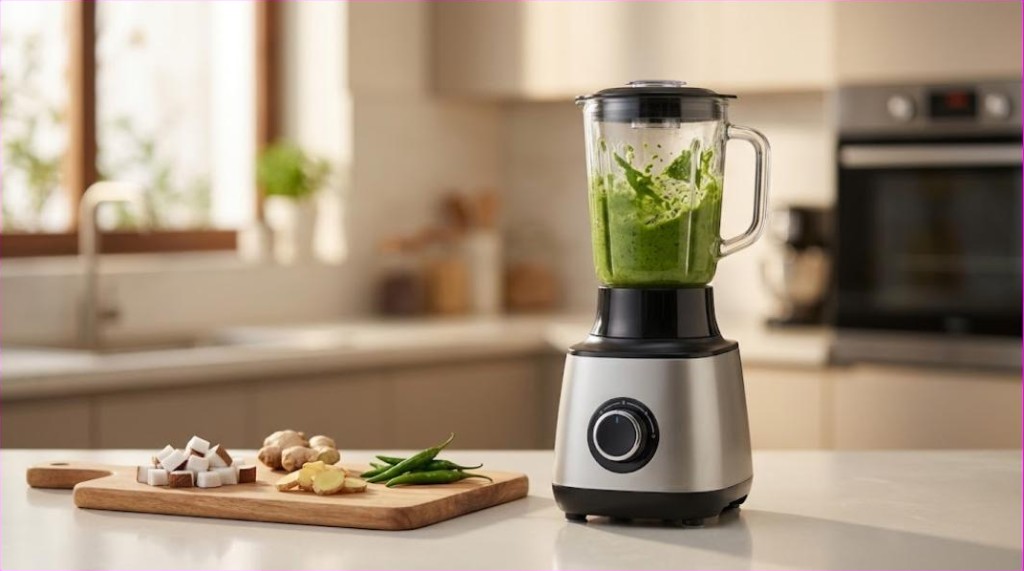
A mixer grinder does a job no Western blender is designed for: grinding hard, dry spices one minute and thick, wet batters the next, several times a week, for years. That duty cycle is why wattage and build quality matter more here than they would in a smoothie blender, and why an underpowered machine tends to fail early rather than simply working slowly.
The specifications worth weighing are fewer than the marketing suggests. Motor power, jar material and whether you make fermented batters will settle most of the decision.
What Actually Matters
Wattage predicts lifespan, not just speed
An underpowered motor asked to grind hard spices does not simply take longer; it draws more current, heats up, and moves closer to failure each time. This is why the cheapest machines often fail within a couple of years in kitchens that grind daily. Buying slightly more power than you need is really buying headroom, and headroom is what keeps a motor out of its overload range.
Jars are not interchangeable, and that is deliberate
The wet jar has blades angled to create a vortex that pulls ingredients down into liquid. The dry jar has a flatter blade profile that keeps powder circulating rather than packing into the corners. Using the wrong jar is the most common reason people conclude their machine grinds badly, when in fact it is doing exactly what that jar is shaped to do.
Heat is why batter is a different problem
A mixer grinder spins fast enough to warm whatever is inside it. For a chutney, irrelevant. For an idli batter that then has to ferment overnight, the temperature rise affects how the culture behaves and can leave the batter flat. This is the single functional reason traditional wet grinders still exist alongside far more convenient machines.
The Main Types and Who Each One Suits
Classic Three-Jar Mixer Grinder
The standard configuration in most Indian kitchens: a wet jar for chutneys and batters, a dry jar for spices and flours, and a small chutney jar for little quantities that would otherwise be lost in a big jar.
- Suits: Everyday all-round Indian cooking.
- Key features: Three purpose-built jars, stainless steel blades, mid-range motor.
High-Wattage Heavy-Duty Model
A more powerful motor with better thermal protection, intended for frequent, demanding use such as grinding hard spices or thick batters without the motor overheating and cutting out.
- Suits: Households cooking large quantities or grinding tough ingredients often.
- Key features: 750W and above, overload protection, sturdier build.
Compact Mixer Grinder
A smaller-footprint machine with reduced jar sizes, covering the same functions at lower volume.
- Suits: Small kitchens, couples, or occasional use.
- Key features: Smaller jars, lighter base, easier to store.
Mixer Grinder with Blender Jar
Adds a tall blender jar to the standard set, for smoothies, milkshakes and larger volumes of liquid that a wet grinding jar handles poorly.
- Suits: Kitchens that want blending as well as grinding.
- Key features: Large-capacity liquid jar, wider range of tasks, single motor base.
Multi-Speed Model with Pulse
Offers a broader range of speeds and a pulse setting, giving finer control for tasks where texture matters, such as a coarse chutney rather than a smooth paste.
- Suits: Cooks who want control over texture rather than one-speed grinding.
- Key features: Variable speed dial, pulse function, more precise results.
Juicer-Mixer-Grinder Combination
Consolidates a juicer attachment onto the same motor base, saving counter space compared with two separate appliances, at the cost of being a compromise at both jobs.
- Suits: Small kitchens wanting juicing without a second appliance.
- Key features: Juicer attachment, shared base, space-saving.
Wet Grinder (Separate Appliance)
Not a mixer grinder at all, but the traditional stone-based machine for idli and dosa batter. It grinds slowly over a long period, which aerates the batter and keeps it cool.
- Suits: Anyone making fermented South Indian batters regularly.
- Key features: Stone grinding surface, slow sustained action, fluffier batter.
What I Use and Why
I run a mid-range three-jar machine and the jar I use most is the small chutney jar, which I did not expect. Small quantities simply do not grind properly in a large jar, because the blades spin above most of the ingredients rather than through them.
The failure I have had was my own fault: I ground a large batch of dry turmeric root in one continuous run and the motor cut out on thermal protection. It recovered after cooling, but it taught me to work in thirty-second bursts with pauses, which the manual had said all along.
How to Choose
Before comparing specific models, it helps to narrow the field on these points:
- Motor wattage relative to how hard and how often you grind
- Number and type of jars, and whether they are stainless steel
- Whether you regularly make idli or dosa batter
- Overload protection and warranty terms on the motor
- Noise level and stability of the base during heavy grinding
Wattage is the specification that most reliably predicts whether a machine will cope. Below about 500W, hard dry spices and thick batters strain the motor, and a strained motor is what burns out. Between 500W and 750W covers most daily cooking comfortably, and above that is worth it if you grind in quantity. Stainless steel jars are preferable to plastic for durability and because they do not retain the smell of strongly flavoured ingredients. If idli and dosa batter is a weekly fixture, a separate wet grinder will outperform any mixer jar, because the slow stone action aerates the batter without heating it.
Care and Common Mistakes
Do not run the motor continuously beyond the time stated in the manual, typically under a minute for heavy loads. Short bursts with rest intervals protect the motor and grind more evenly anyway.
Never fill a jar past its marked line, particularly with liquids. An overfilled wet jar leaks past the gasket and liquid reaching the motor coupling is a common cause of failure.
Check and replace the jar gaskets when they harden. A perished gasket leaks slowly and is often mistaken for a cracked jar.
Frequently Asked Questions
What wattage mixer grinder do I actually need?
For everyday chutneys, spice grinding and moderate batches, 500W to 750W is sufficient. Above 750W is worth it if you grind hard spices frequently or work in large quantities, mainly because the motor runs further from its limit and lasts longer.
Why does my mixer grinder smell like burning?
Usually because the motor is being overloaded, either by grinding too much at once, running it continuously for too long, or attempting a task better suited to a wet grinder. Work in smaller batches with rest intervals between runs, and check the manual for the recommended maximum continuous running time.
Do I need a separate wet grinder if I have a mixer grinder?
Only if you make fermented batters regularly. A mixer jar heats the batter as it grinds, which affects fermentation and texture, whereas a stone wet grinder works slowly and keeps it cool. For occasional batter, a mixer grinder is workable; for weekly idli, a wet grinder is a genuine upgrade.

Hi! I’m the creator of scooks (Simple Cooks).I share easy, practical recipes and simple cooking ideas to help you enjoy everyday home cooking with confidence.
Happy cooking! 🍽️