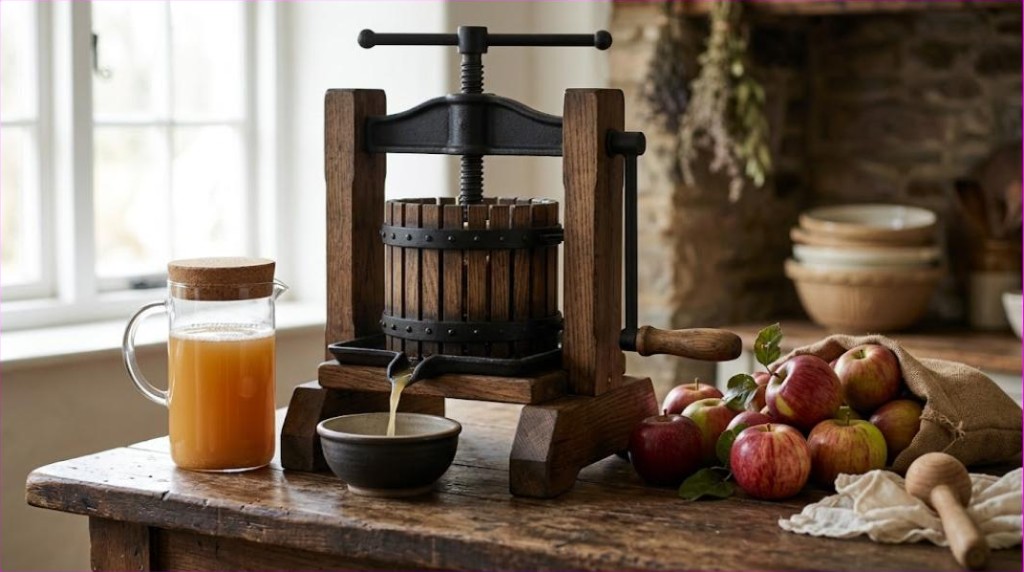
Making your own apple cider at home is one of those satisfying fall traditions that doesn’t need much beyond fresh fruit, a crusher, and a press. The right press comes down to how much fruit you’re processing and how much counter or garage space you have to store it. This guide breaks down the main types on the market so you can match one to how you actually plan to use it.
What Actually Matters
Extraction pressure, not size
The number that decides how much juice you get out of a bushel of apples is pressure, not capacity. A hand-turned screw press applies whatever force your arms can generate, which is usually enough to reach around two and a half gallons per bushel. A hydraulic press applies far more, consistently, and can push that yield higher from the same fruit. If you are buying a press to process a serious harvest, the pressure mechanism matters more than the size of the basket.
Whether it crushes as well as presses
This is the detail most first-time buyers miss. A press alone squeezes fruit that has already been broken down into pomace. Whole apples fed into a basket press mostly just roll around under the plate. Either the press includes a crusher hopper, or you need a separate crusher, or you are chopping bushels of apples by hand, which is genuinely miserable work after the first twenty pounds.
Cleaning and storage between seasons
A press gets used for a few weeks a year and then has to live somewhere for eleven months. Slatted wooden baskets absorb juice and need thorough drying to avoid mould; stainless steel rinses clean in minutes. Wooden presses are also heavy and awkward to move, which matters if the only storage you have is a shelf rather than a garage corner.
The Main Types and Who Each One Suits
Traditional Wooden Basket Press
The classic farmhouse-style press: a slatted wooden basket under a screw-driven plate, built for durability and a rustic look. It’s slower to operate than newer designs but extracts juice thoroughly and lasts for decades with basic care.
- Suits: Home orchardists who want a traditional setup that will last a lifetime.
- Key features: Solid wood basket, cast-iron screw mechanism, large juice capacity per pressing.
Ratchet or Screw Basket Press
A more compact, often stainless-steel version of the basket press, using a ratchet handle for easier, faster pressure application than a hand screw.
- Suits: Smaller batches and easier one-person operation.
- Key features: Stainless steel frame, ratchet mechanism, easier cleanup than wood.
Steam Juicer
Rather than pressing, a steam juicer extracts juice by gently steaming fruit in a stacked pot system, which also lightly pasteurizes the juice as it goes.
- Suits: Anyone who wants juice that’s ready to can immediately, no separate pasteurizing step.
- Key features: Stacked pot design, works on any stovetop, doubles as a general steamer/juicer for berries and grapes.
Manual Crusher and Press Combo
A two-in-one setup that chops whole apples into pomace before pressing, saving the step of hand-chopping fruit ahead of time.
- Suits: Processing whole apples straight from the tree without pre-cutting.
- Key features: Hand-crank crusher hopper, attached or paired basket press, moderate batch capacity.
Hydraulic Press
Uses a hydraulic jack instead of a hand screw to apply much higher, more consistent pressure, extracting noticeably more juice per pound of fruit.
- Suits: Serious home cider makers processing large volumes each season.
- Key features: Hydraulic ram mechanism, higher juice yield, heavier and pricier than basic screw presses.
Bladder (Bag) Press
An inflatable bladder inside a cage applies even pressure from the inside out, commonly used by small commercial and serious hobbyist producers for higher juice clarity.
- Suits: Cider makers who care about juice clarity and consistent extraction.
- Key features: Inflatable bladder mechanism, even pressure distribution, easier cleanup than slatted baskets.
Compact Countertop Manual Press
A small-batch press sized for a kitchen counter, good for a few pounds of fruit at a time rather than a full harvest.
- Suits: Apartment dwellers or anyone without garage or basement storage space.
- Key features: Small footprint, lightweight, easy to store between uses.
What I Use and Why
For the volume I actually press, which is maybe four or five bushels of apples over a couple of autumn weekends, a mid-sized screw basket press with a separate crusher has been the right call. The first year I tried to manage without a crusher and hand-chopped the fruit, and it took longer than the pressing itself. That was the purchase that actually changed the day.
I have used a steam juicer as well, and it is a genuinely different tool rather than a cheaper press. The juice comes out already hot and effectively pasteurized, which is ideal if you are canning, but it tastes cooked rather than fresh, and you cannot make cider from it in the traditional sense. Worth knowing before buying one expecting a press substitute.
How to Choose
Before comparing specific models, it helps to narrow the field on these points:
- Build material and durability (wood vs. stainless steel vs. cast iron)
- Batch size and how much fruit it can process per run
- Ease of cleaning between uses
- Storage footprint when not in use
- Whether it includes a crusher, or needs fruit pre-chopped
If you’re processing a full backyard harvest, prioritize capacity and a built-in crusher — hand-chopping bushels of apples gets old fast. For smaller batches or apartment living, a compact manual press is more practical to store. Steam juicers are worth considering if you want juice that’s ready to can without a separate pasteurization step, and hydraulic or bladder presses are the upgrade path once you’re pressing seriously large volumes each fall.
Care and Common Mistakes
The single most common mistake is not cleaning the press immediately. Apple pomace dries onto slats and screw threads within a couple of hours and becomes very difficult to remove. Rinsing everything down while the pulp is still wet takes a few minutes; leaving it until the evening turns into a scrubbing job.
The second is storing a wooden press while it is still damp. Wood that goes into storage wet will grow mould over the winter, and you will find out about it the following autumn. Let it dry completely in open air first, ideally for a day or two.
Finally, do not overfill the basket. It is tempting to load as much pomace as will physically fit, but an overfilled basket squeezes unevenly and pulp escapes around the edges rather than releasing juice. Two smaller pressings extract more than one overloaded one.
Related Reading
Frequently Asked Questions
How much juice can I expect from a bushel of apples?
A general rule of thumb is about 2.5 to 3 gallons of juice per bushel (roughly 42 lbs) of apples, though this varies by apple variety and press efficiency.
Do I need to peel or core apples before pressing?
No — whole apples, including skin, core, and seeds, are typically crushed and pressed together. Just remove any stems and damaged, moldy fruit.
Can I use a cider press for other fruits besides apples?
Yes, most presses work well for pears, grapes, and other pome or soft fruits, though very soft fruits like berries are usually better suited to a steam juicer.

Hi! I’m the creator of scooks (Simple Cooks).I share easy, practical recipes and simple cooking ideas to help you enjoy everyday home cooking with confidence.
Happy cooking! 🍽️