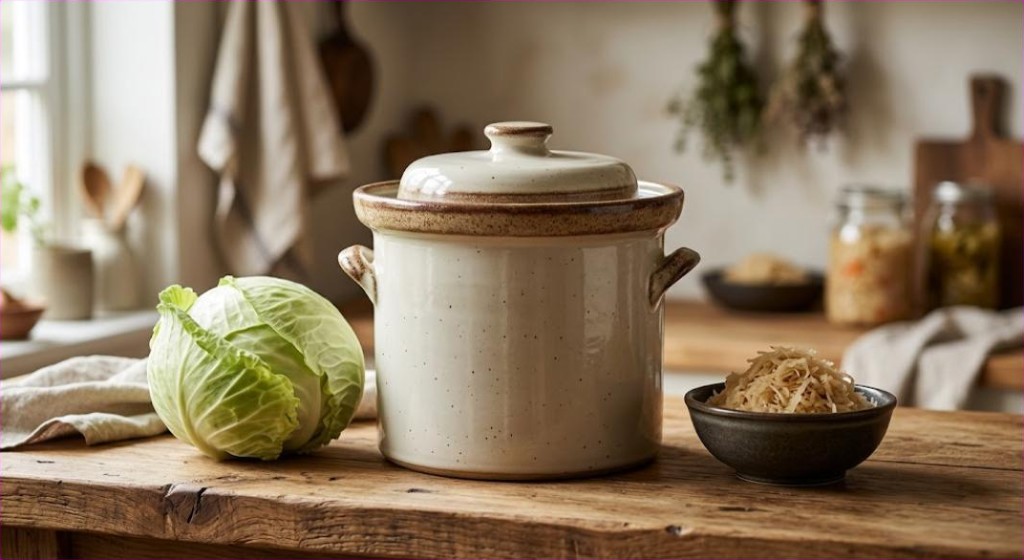
A dedicated fermentation crock takes the guesswork out of keeping cabbage submerged and protected from air — the two things that matter most for safe, successful sauerkraut and kimchi. Most designs use either a water-filled channel around the rim (a water-seal crock) or a modern airlock to let fermentation gases escape without letting air or pests in.
What Actually Matters
Both seals solve the same problem differently
Fermentation produces carbon dioxide that has to escape, while oxygen has to be kept out. A water-seal crock does this with a moat around the rim that the lid sits in, so gas bubbles out through the water. An airlock does it with a one-way valve. Functionally they are equivalent; the practical difference is that a water channel evaporates and needs topping up, while an airlock does not but is another small part to clean.
Weights matter more than the crock
Whatever vessel you use, the vegetables must stay under the brine, and that is the job of the weights. Traditional crocks come with heavy stone half-moons that do this well. If you buy a crock without weights, or improvise with a jar of water, you will spend the whole ferment pushing cabbage back down, and anything that surfaces is where problems start.
The Main Types and Who Each One Suits
Traditional German Water-Seal Crock
The classic stoneware design with a water-filled channel around the rim; the lid sits in the channel, letting gas bubble out while blocking air and contaminants from getting in.
- Suits: Traditionalists who want the time-tested design.
- Key features: Stoneware body, water-channel seal, usually includes stone weights.
Polish-Style Stoneware Crock
A regional variation on the water-seal design, often with a slightly different weight and lid shape but the same core sealing principle.
- Suits: Fans of Eastern European fermentation traditions.
- Key features: Stoneware construction, water-seal lid, traditional stone weights.
Mini Countertop Crock
A smaller-capacity water-seal crock sized for a few pounds of cabbage at a time, more practical for households that don’t ferment in bulk.
- Suits: Small batches and limited counter or pantry space.
- Key features: Reduced capacity, compact footprint, same water-seal mechanism as larger crocks.
Glass Fermentation Crock with Weights
Swaps opaque stoneware for clear glass, letting you visually monitor the ferment’s progress without opening the lid.
- Suits: Beginners who want to watch what’s happening inside.
- Key features: Clear glass body, included glass or ceramic weights, visual progress tracking.
Wide-Mouth Jar Fermentation Kit
Uses a standard wide-mouth mason jar fitted with an airlock lid and a weight, a lower-cost and lower-capacity alternative to a full crock.
- Suits: Small-batch fermenting or trying the hobby before investing in a crock.
- Key features: Fits standard mason jars, airlock lid, glass fermentation weight.
Large Batch Ceramic Crock
A bigger-capacity stoneware crock for households that ferment large quantities at once, such as a whole case of cabbage for the season.
- Suits: Serious fermenters processing large harvests.
- Key features: High capacity (5+ gallons), traditional water-seal design, heavier stoneware construction.
Modern Airlock Crock
Replaces the traditional water channel with a compact one-way airlock valve, similar to what’s used in home brewing, for a lower-profile seal.
- Suits: Fermenters who prefer a compact, brewing-style airlock over a water channel.
- Key features: One-way airlock valve, often ceramic or ceramic-coated body, no water channel to maintain.
What I Use and Why
I ferment in a one-gallon water-seal crock and it suits roughly five pounds of cabbage, which is about one large head plus a bit. The mistake I made early was forgetting to top up the water channel. It evaporated over about ten days, the seal broke without any obvious sign, and I ended up with a surface layer that had to be discarded.
For small experimental batches I still use jars rather than the crock, simply because a gallon of a flavour I turn out not to like is a lot of sauerkraut to work through.
How to Choose
Before comparing specific models, it helps to narrow the field on these points:
- Sealing method — water channel vs. airlock
- Material — traditional stoneware vs. glass
- Capacity relative to how much you typically ferment at once
- Included weights to keep vegetables submerged
- Ease of monitoring progress without breaking the seal
Capacity is the main practical decision — a 1-gallon crock suits a household making occasional small batches, while anything fermenting whole cases of cabbage should look at 5-gallon or larger stoneware. Water-seal crocks need their channel topped up with water periodically as it evaporates, so check that before committing if you tend to forget maintenance tasks. Whatever you choose, make sure it comes with (or you separately buy) weights heavy enough to keep vegetables fully submerged under the brine.
Care and Common Mistakes
Top up the water channel on a water-seal crock every few days. It is the one maintenance task these vessels have and forgetting it silently defeats the whole design.
Do not use metal utensils or metal weights in an active ferment. The acidity reacts with reactive metals, and this can affect both flavour and the culture.
Wash the crock with hot water and avoid strong detergents, which can linger in unglazed stoneware and inhibit the next ferment. Dry it thoroughly before storage.
Frequently Asked Questions
What’s the difference between a water-seal crock and an airlock?
A water-seal crock uses a channel of water around the rim that the lid sits in, letting gas escape as bubbles while blocking air. An airlock uses a small one-way valve instead — both achieve the same goal of releasing fermentation gas without letting air back in.
Do I need a fermentation crock, or can I use a regular jar?
A dedicated crock makes keeping vegetables submerged and sealed easier, especially for larger batches, but a wide-mouth mason jar with a simple weight and a loosely fitted lid works fine for smaller quantities.
How much cabbage fits in a typical fermentation crock?
A common 1-gallon crock holds roughly 5 pounds of shredded cabbage, while larger 5-gallon crocks can handle a full case — check the specific crock’s stated capacity, since designs vary.

Hi! I’m the creator of scooks (Simple Cooks).I share easy, practical recipes and simple cooking ideas to help you enjoy everyday home cooking with confidence.
Happy cooking! 🍽️