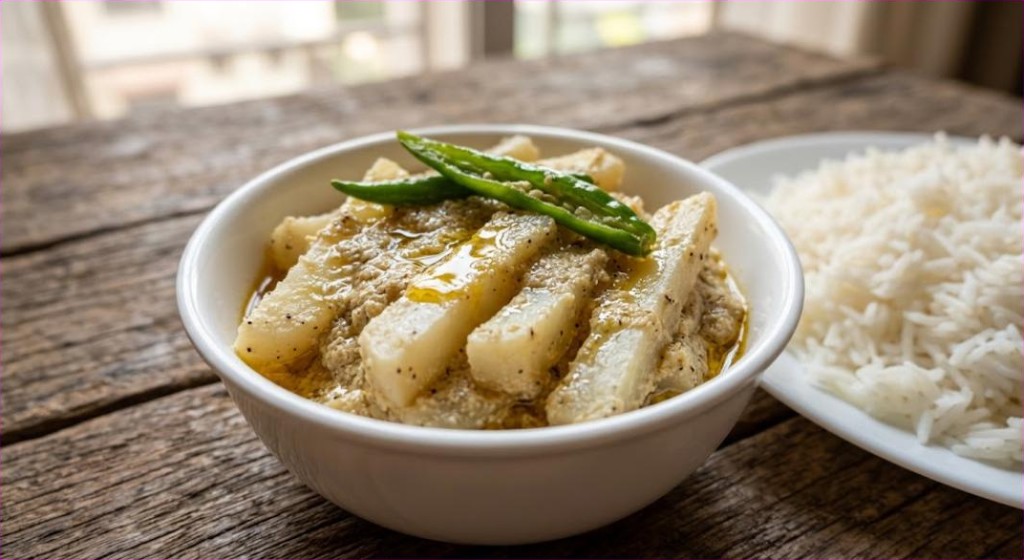
Aloo posto is about as simple as Bengali cooking gets, and that’s exactly why it’s a staple on lunch tables across West Bengal. Potatoes are simmered in a paste of ground white poppy seeds, green chili, and a little onion or garlic, finished with pungent mustard oil. The result is mild, slightly nutty, and comforting in a way that’s hard to explain until you’ve tasted it.
The whole dish comes together in under 40 minutes and needs nothing more than rice on the side. It’s traditionally a weekday lunch dish, but it holds its own on a festive Bengali thali too.
- Prep15 min
- Cook20 min
- Total35 min
- Serves3-4 servings
- CourseSide Dish
- CuisineBengali / Indian
Written by Anisha Akter · Updated 7 September 2026
Why This Recipe Works
Everything about aloo posto depends on how well the poppy seeds are broken down. White poppy seeds are small and hard, with the oils locked inside intact cell walls. Soaking them in warm water for at least thirty minutes softens those walls so a grinder can actually rupture them rather than just knocking the seeds around. That is why an under-soaked batch tastes gritty and thin: the seeds have been chopped, not ground, and the nutty oils that carry the flavour are still trapped inside.
Mustard oil is the other half of the dish. Raw mustard oil carries a sharp, sinus-clearing pungency from allyl isothiocyanate, which is volatile. Heating the oil until it just begins to smoke drives most of that compound off and leaves a rounder, warmer flavour behind. Bengali cooks have done this for generations before adding any spice, and skipping it is the most common reason a first attempt tastes harsh rather than mellow.
The finished dish should be dry, with the paste clinging to the potato rather than pooling underneath. Half a cup of water is enough to steam the cubes through under a lid; anything more and you end up with a thin gravy that misses the point of the dish entirely.
Ingredients
White poppy seeds (posto) are sold at South Asian grocers. Soak them well before grinding — this is the step that keeps the paste smooth instead of gritty.
- 1/4 cup white poppy seeds (posto), soaked in warm water for 30 minutes
- 2-3 green chilies, plus 1 extra for tempering
- 3 medium potatoes, peeled and cut into 1-inch cubes
- 3 tbsp mustard oil
- 1/2 tsp nigella seeds (kalonji)
- 1/4 tsp turmeric powder
- Salt, to taste
- 1/2 cup water
- 1 tsp mustard oil, raw, for finishing (optional but traditional)
Step-by-Step Instructions
- Drain the soaked poppy seeds and grind them with 2-3 green chilies and a splash of water into a smooth, thick paste. A small food processor or wet grinder works better than a standard blender for this quantity.
- Heat the mustard oil in a kadai or heavy pan until it just starts to smoke, then lower the heat slightly — this cooks off the raw sharpness of the oil.
- Add the nigella seeds and the extra whole green chili, and let them sizzle for 15-20 seconds.
- Add the cubed potatoes and turmeric, and sauté over medium heat for 5-6 minutes until the edges start to turn light golden.
- Stir in the poppy seed paste and salt, coating the potatoes evenly, and cook for 2-3 minutes until the raw smell of the paste fades.
- Add the water, cover, and simmer over low heat for 12-15 minutes, stirring occasionally, until the potatoes are fork-tender and the paste clings to them rather than pooling as a thin sauce.
- Drizzle with a teaspoon of raw mustard oil just before serving, if you like the extra sharpness, and serve hot with steamed rice.
What I Learned Testing This Recipe
My first attempt was noticeably gritty, and I blamed the recipe before I blamed my technique. I had soaked the poppy seeds for about ten minutes because I was in a hurry. Thirty minutes in genuinely warm water, not lukewarm, fixed it completely on the next try. If your blender is a standard full-size jug rather than a small grinder jar, the quantity here is too small to circulate properly, so a spice grinder or a small chutney jar works far better.
I also over-thinned the paste the first couple of times. It is tempting to keep adding water to help the blades move, but past a certain point you are just diluting rather than grinding. A tablespoon at a time, scraping the sides down between pulses, gets you a smoother paste with less water than you would expect.
The potato size matters more than it sounds. I cut them unevenly once and ended up with some cubes falling apart while others were still firm in the middle. Roughly one-inch pieces, cut as evenly as you can manage, cook through together in about the same twelve to fifteen minutes.
Tips for Success
- Soaking the poppy seeds for a full 30 minutes (longer if your blender is weak) is the single biggest factor in a smooth, non-gritty paste.
- Mustard oil is traditional and gives aloo posto its characteristic pungency, but a neutral oil works if you can’t find it or prefer a milder taste.
- Keep the potato pieces roughly the same size so they cook evenly.
- This dish should be fairly dry, clinging to the potatoes — if it looks too soupy, uncover and simmer a few extra minutes.
Variations
- Peyaj posto: add a diced onion along with the potatoes for a sweeter, more filling version.
- Begun posto: swap in cubed eggplant, or use a mix of eggplant and potato.
- Posto bora: shape the raw poppy seed paste into small patties and shallow-fry them as a side, served alongside plain rice and dal.
- Garlic posto: grind 2-3 garlic cloves in with the poppy seeds for a sharper flavor.
Storage and Make-Ahead
Aloo posto keeps in the refrigerator for up to 2 days in an airtight container. It’s best reheated gently in a pan with a splash of water, as the poppy seed paste can separate slightly in the microwave. It doesn’t freeze well due to the potato texture.
Frequently Asked Questions
What are poppy seeds called in Bengali cooking?
They’re called posto, and specifically white poppy seeds are used, not the dark ones common in baking. Posto dishes — aloo posto, begun posto, posto bora — are a distinct and beloved category in Bengali cuisine.
Why is my poppy seed paste gritty?
Insufficient soaking is the usual cause. Soak the seeds in warm water for at least 30 minutes, and grind with just enough water to keep the blades moving — too much water makes the paste thin without making it smoother.
Can I make aloo posto without mustard oil?
Yes, though mustard oil is what gives the dish its traditional pungent edge. A neutral oil like sunflower or a light olive oil will still produce a good, milder version.
Hi! I’m the creator of scooks (Simple Cooks).I share easy, practical recipes and simple cooking ideas to help you enjoy everyday home cooking with confidence.
Happy cooking! 🍽️