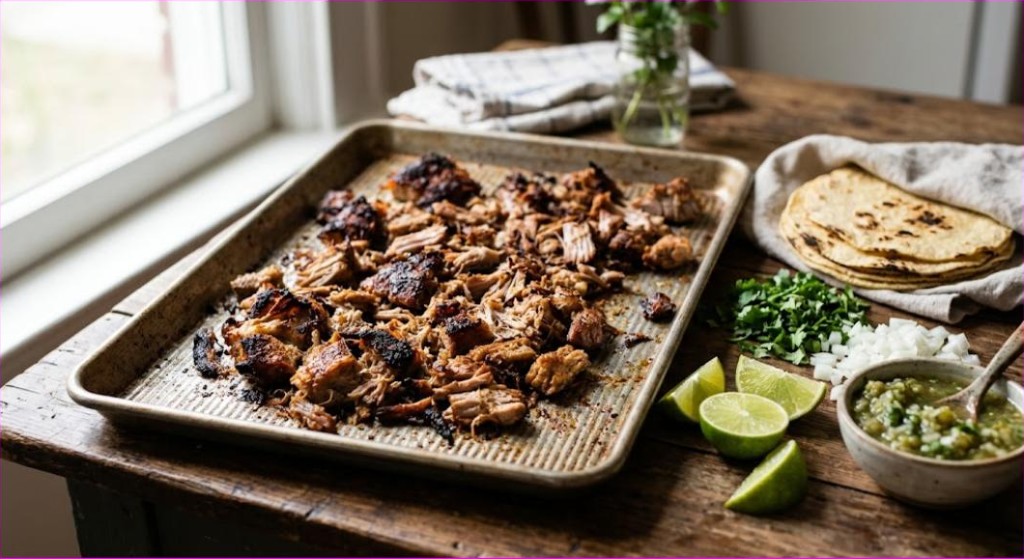
Carnitas means little meats, and the dish comes from Michoacán, where pork is traditionally simmered slowly in its own lard in a large copper pot until it is falling apart and the edges have gone crisp and lacquered. That contrast — soft, juicy shreds with crackling brown edges — is the whole point.
Most home carnitas recipes deliver the first half and miss the second. You get tender pulled pork, which is good, but it is not carnitas until something has crisped. The confit method is impractical for most kitchens, so the reliable home approach is to braise the pork until tender, shred it, then spread it on a sheet pan under high heat with a little of its own cooking liquid spooned over.
This takes about three and a half hours, almost all of it unattended, and makes enough for eight people with tortillas. The active work is maybe twenty-five minutes total.
- Prep20 min
- Cook3 hr
- Total3 hr 20 min
- Serves8 servings
- CourseMain Course
- CuisineMexican
Written by Anisha Akter · Updated 24 September 2026
Why This Pork Carnitas Recipe Works
- Pork shoulder has enough collagen and fat to survive three hours of braising and emerge tender rather than dry.
- Orange and lime juice add acidity that balances the fat and helps break down connective tissue.
- The pork is braised uncovered for the last hour so the liquid reduces into a concentrated, glossy sauce.
- Broiling the shredded meat is what produces the crisp edges that define real carnitas.
- Spooning reduced cooking liquid over the meat before broiling means the crisped bits are flavoured, not just dry.
Ingredients and Why They Matter
Pork shoulder is not negotiable here. The rest is adjustable to taste.
- 4 lb (1.8 kg) boneless pork shoulder (Boston butt), cut into 2-inch chunks
- 2 tbsp salt
- 1 tbsp ground cumin
- 2 tsp dried oregano, preferably Mexican
- 1 tsp freshly ground black pepper
- 1/2 tsp ground cinnamon
- 2 tbsp neutral oil or lard
- 1 large onion, quartered
- 6 cloves garlic, smashed
- 2 bay leaves
- Juice of 2 oranges (about 2/3 cup)
- Juice of 2 limes
- 1 cup (240 ml) chicken stock or water
- Corn tortillas, white onion, cilantro and lime wedges, to serve
Key Ingredient Notes
Pork shoulder (Boston butt). This cut is marbled with fat and threaded with collagen, which melts into gelatin over a long braise and gives the meat its succulent texture. Pork loin and tenderloin are far too lean and will turn stringy and dry no matter how you cook them.
Orange juice. The classic Michoacán version uses bitter Seville oranges. Regular orange juice with a squeeze of lime approximates that sweet-sour profile. The acid tenderises and the sugars help the edges caramelise under the broiler.
Mexican oregano. A different plant from Mediterranean oregano, with citrus and grassy notes rather than the minty ones. If you only have Italian oregano use slightly less, since it is more assertive in a different direction.
A little cinnamon. Half a teaspoon is not enough to taste as cinnamon but it adds warmth underneath the cumin. It is a common touch in Mexican pork dishes and its absence is noticeable once you have had it.
Step-by-Step Instructions
- Pat the pork chunks dry and toss them with the salt, cumin, oregano, black pepper and cinnamon until evenly coated.
- Heat the oil in a large Dutch oven over high heat. Brown the pork in three batches, about 3 minutes per side, until deeply coloured. Do not crowd the pot. Set the browned pieces aside.
- Reduce the heat to medium and add the onion quarters and smashed garlic. Cook 3 minutes, scraping the browned bits off the bottom.
- Return the pork and any juices to the pot. Add the bay leaves, orange juice, lime juice and stock. The liquid should come about halfway up the meat, not cover it.
- Bring to a simmer, cover, and transfer to a 300°F (150°C) oven. Cook for 2 hours.
- Uncover and cook for a further 45 to 60 minutes, until the pork pulls apart easily with a fork and the liquid has reduced to a thick, dark layer in the bottom of the pot.
- Remove the pork to a bowl and shred it with two forks into large chunks rather than fine threads. Discard the bay leaves and onion.
- Skim most of the fat off the cooking liquid and reserve both the fat and the liquid separately. Set the oven to broil with a rack 6 inches from the element.
- Spread the shredded pork in a single layer on a rimmed baking sheet. Do not pile it up — anything in a second layer will steam instead of crisping.
- Spoon about 1/2 cup of the reduced cooking liquid and a tablespoon of the reserved fat evenly over the meat.
- Broil for 5 to 7 minutes until the top edges are browned and crisp. Toss, spoon over a little more liquid, and broil 3 to 5 minutes more.
- Serve straight away with warm corn tortillas, finely diced white onion, cilantro and lime.
Common Mistakes and How to Avoid Them
Skipping the broiling step Braised pork is pulled pork. Carnitas require crisped edges, and five minutes under a broiler is what creates them. This is the step that separates the dish from a generic slow-cooker recipe.
Piling the pork on the sheet pan Meat in a mound steams in its own moisture and stays soft. Spread it in a genuine single layer, using two pans if you need to.
Using a lean cut Pork loin has almost no intramuscular fat or collagen. Three hours of braising turns it into dry fibres. Shoulder is the cut that works, and it is usually the cheaper one.
Covering the pork in liquid Carnitas are braised, not boiled. Liquid halfway up the meat lets the exposed top brown while the bottom cooks in the braise. Fully submerged pork tastes washed out.
Tips for Best Results
- Shred into chunks rather than fine strands. Larger pieces have more surface to crisp and stay juicier inside.
- The reduced cooking liquid is the most flavourful thing in the pot. Use it on the meat before broiling and keep the rest for reheating leftovers.
- Warm the tortillas directly over a gas flame or in a dry skillet for 20 seconds a side. Cold tortillas undercut everything else you have done.
- A slow cooker works for the braise: 8 hours on low with only half the liquid, since slow cookers lose almost no moisture. You still need the broiler at the end.
- Carnitas are better the next day. The flavour deepens overnight and the broiling step re-crisps them perfectly.
Variations to Try
Carnitas tacos. The standard serving. Corn tortillas, diced white onion, cilantro, salsa verde and lime. Nothing else is needed.
Carnitas bowls. Over cilantro-lime rice with black beans, pickled onion and avocado. A practical way to use leftovers.
Instant Pot carnitas. Pressure cook on high for 45 minutes with half the liquid, natural release for 15 minutes, then shred and broil as directed. Total time under 90 minutes.
Chicken carnitas. Use bone-in chicken thighs and reduce the braise to 45 minutes. The texture is different but the broiled edges work the same way.
Storage, Freezing and Reheating
Refrigerate the shredded pork with some of its cooking liquid for up to 4 days. Storing it dry makes it tough on reheating.
Reheat by spreading on a sheet pan with a little liquid and broiling for 4 to 5 minutes. This restores the crisp edges better than any other method.
Freeze in portions with cooking liquid for up to 3 months. Thaw overnight in the fridge, then broil to crisp.
What to Serve With It
Frequently Asked Questions
What cut of pork is best for carnitas?
Boneless pork shoulder, also sold as Boston butt or pork butt. It has the fat and collagen the dish needs. Picnic shoulder also works. Avoid loin and tenderloin entirely.
How do I get carnitas crispy?
Spread the shredded meat in a single layer on a sheet pan, spoon over some of the reduced cooking liquid and fat, and broil for five to seven minutes. Piling the meat or skipping the liquid both prevent proper crisping.
Can I make carnitas in a slow cooker?
Yes. Brown the pork first, then cook on low for 8 hours with about half the liquid called for here, since slow cookers trap all the moisture. Finish under the broiler.
Why are my carnitas dry?
Either the cut was too lean, or the meat was stored and reheated without any cooking liquid. Always keep some braising liquid with the shredded pork.
What is the difference between carnitas and pulled pork?
Carnitas are Mexican, braised with citrus and spices, and finished until the edges crisp. American pulled pork is usually smoked, sauced with barbecue sauce, and stays uniformly soft.
Can I freeze carnitas?
Yes, and they freeze very well for up to three months. Freeze the shredded meat with some of its liquid, then thaw and broil to bring back the crisp edges.

Hi! I’m the creator of scooks (Simple Cooks).I share easy, practical recipes and simple cooking ideas to help you enjoy everyday home cooking with confidence.
Happy cooking! 🍽️