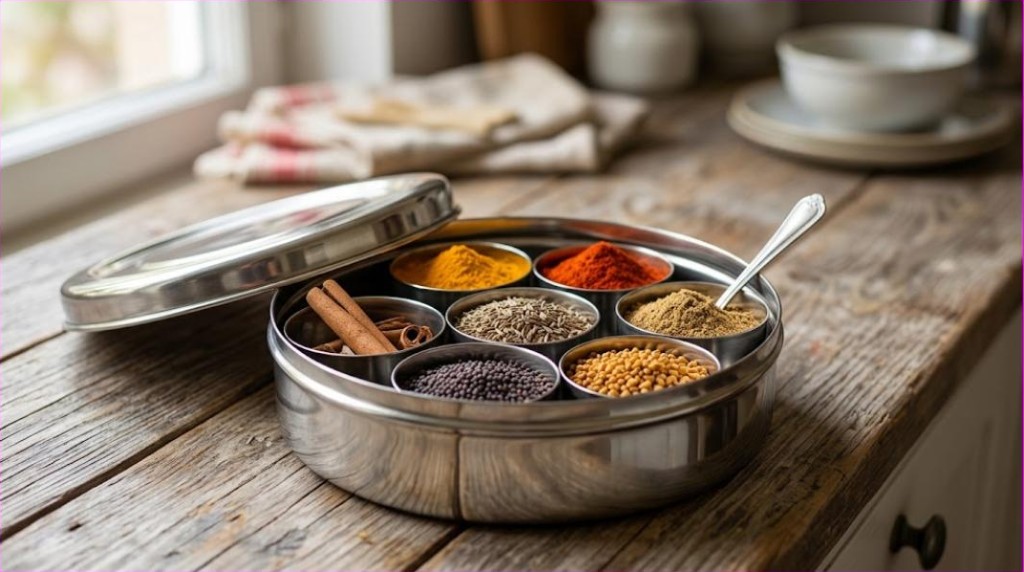
A masala dabba is the small round spice tin that sits on every Indian kitchen counter, holding the handful of spices you reach for daily — turmeric, cumin, coriander, chili, and a few others — within a single lid-lift. The right one comes down to capacity, material, and how well the inner lid seals against moisture and pests. Here’s a rundown of the main styles worth considering.
What Actually Matters
The lid seal does the real work
A masala dabba is a storage container first and a convenience second. Ground spices lose their volatile aromatic oils on contact with air and humidity, and in a hot, humid kitchen an ill-fitting outer lid means noticeably duller turmeric and coriander within weeks. When you are comparing boxes, the fit of the outer lid is worth more attention than the finish or the decoration.
Bowl count versus how you actually cook
Seven bowls is the standard because most Indian home cooking runs on roughly that many everyday spices. If you cook across several cuisines, seven fills up fast and you end up storing overflow elsewhere, which defeats the point. Counting the spices you genuinely reach for weekly, rather than the ones you own, is the honest way to size a dabba.
Material and what it does to flavour over time
Stainless steel is neutral, washes clean and does not hold odours, which is why it dominates. Wood looks better and insulates from light but absorbs oils from strong spices like asafoetida, and that smell transfers. Copper-lined boxes are attractive and traditional but need more maintenance than most people expect.
The Main Styles and Who Each One Suits
Classic 7-Bowl Stainless Steel Dabba
The standard configuration found in most Indian kitchens: a round steel tin with seven small removable bowls and a tight-fitting outer lid.
- Suits: Everyday use as the primary spice station.
- Key features: Stainless steel construction, 7 removable bowls, small built-in spoon.
Wooden Spice Box
A more traditional, often handcrafted alternative to steel, usually with a sliding or hinged lid and individually carved compartments.
- Suits: Kitchens going for a rustic or heirloom look.
- Key features: Solid wood construction, natural insulation from light, distinctive traditional style.
Compact Travel Dabba
A smaller-capacity version designed to pack in a suitcase or lunch bag for carrying a few essential spices while traveling or eating away from home.
- Suits: Frequent travelers who don’t want to rely on unfamiliar spice blends.
- Key features: Reduced size, 3-4 mini compartments, secure locking lid.
Copper-Lined Dabba
Combines a steel or brass exterior with a copper-lined interior, valued in some households for both tradition and copper’s mild antimicrobial properties.
- Suits: Traditional households that prefer copper cookware throughout the kitchen.
- Key features: Copper-lined bowls, brass or steel body, decorative finish.
Glass-Lid Dabba
Uses a clear glass or acrylic outer lid instead of solid metal, so you can identify spices without opening it.
- Suits: Anyone who wants to visually check spice levels at a glance.
- Key features: Transparent lid, steel body and bowls, easy visual inventory.
Double-Layer Dabba
Stacks two tiers of spice bowls to roughly double capacity without doubling the counter footprint, useful for households that cook a wide range of cuisines.
- Suits: Larger families or those who keep a bigger spice rotation.
- Key features: Two stacked tiers, up to 14 compartments, single outer lid.
Individual Spice Jars Set
Rather than one round tin, this is a matched set of small individual jars, giving more flexibility in arrangement but losing the single-lid convenience.
- Suits: Kitchens with pantry shelf storage rather than counter space.
- Key features: Individually sealed jars, flexible arrangement, easier to wash one at a time.
What I Use and Why
I use a plain seven-bowl stainless steel dabba, and the thing that made the biggest practical difference was not the box itself but refilling it in small quantities. I used to fill each bowl to the brim from a large bag, and the spice at the bottom would sit there for months losing potency. Now I refill roughly fortnightly with less in each bowl, and the difference in aroma is obvious.
I also tried a wooden box for a while because it looked better on the counter. It worked, but the asafoetida compartment permanently smelled of asafoetida even after washing, and that faint smell carried into whatever went in that bowl next. I went back to steel and keep hing in its own small separate jar.
How to Choose
Before comparing specific models, it helps to narrow the field on these points:
- Number and size of inner bowls (typically 5-9)
- Lid seal quality, to keep spices fresh and pest-free
- Material — stainless steel, wood, or copper-lined
- Ease of labeling and identifying spices at a glance
- Overall size relative to counter or cabinet space
Stainless steel is the most practical everyday choice — it’s dishwasher-safe, doesn’t absorb odors, and lasts indefinitely. Prioritize a snug-fitting outer lid over decorative extras, since that’s what actually keeps spices fresh and free of pantry pests. If your spice rotation goes beyond the standard seven, look at double-layer tins or a set of individual jars instead of overcrowding a single-tier dabba.
Care and Common Mistakes
Do not store the dabba next to the hob. It is the most convenient spot and the worst one, because the repeated heat and steam accelerate the loss of aroma and can cake ground spices into solid lumps. A cupboard or a spot on the counter away from direct heat keeps spices usable much longer.
Wash and dry the bowls completely before refilling. Even slight residual moisture will clump ground spices and, in humid weather, can start mould. Air-drying fully rather than towel-drying is worth the extra few minutes.
Whole spices keep their flavour far longer than ground ones, so where a recipe allows it, storing cumin, coriander and pepper whole and grinding as needed will always beat buying pre-ground powder for the same box.
Frequently Asked Questions
What spices normally go in a masala dabba?
The exact mix varies by household and region, but common choices are turmeric, red chili powder, coriander powder, cumin seeds, mustard seeds, garam masala, and asafoetida (hing).
How do I keep spices fresh longer in a masala dabba?
Keep the tin away from direct heat and sunlight, make sure the lid seals tightly, and refill smaller quantities more often rather than storing months’ worth of ground spice at once, since ground spices lose potency faster than whole ones.
Is stainless steel or wood better for a spice box?
Stainless steel is easier to clean and more resistant to moisture and pests, making it the more practical everyday choice, while wood is chosen mainly for its traditional look and feel.

Hi! I’m the creator of scooks (Simple Cooks).I share easy, practical recipes and simple cooking ideas to help you enjoy everyday home cooking with confidence.
Happy cooking! 🍽️