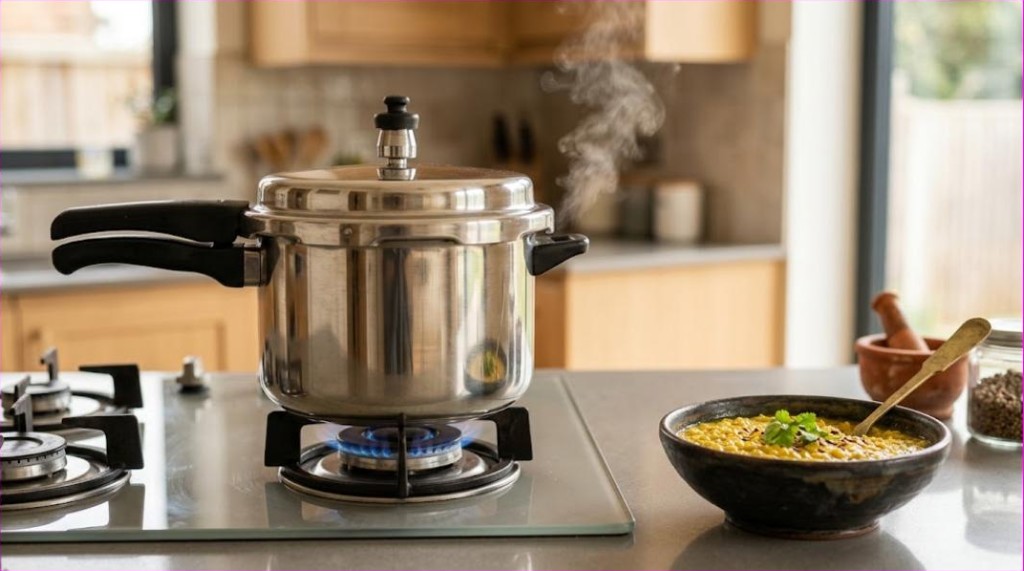
The whistle-count method of Indian pressure cooking — timing dal or rice by how many whistles the cooker releases — is deeply ingrained in how most Indian households cook daily staples fast. Whether you stick with a traditional stovetop whistle cooker or move to an electric multi-cooker with presets, the right choice depends on your stovetop and how much you value hands-off convenience.
What Actually Matters
What a whistle actually measures
A whistle is the weighted valve lifting to release excess pressure, so counting whistles is really a rough measure of how long the cooker has been at full pressure. That is why whistle counts are not portable between cookers: a different valve weight, a different pot size or a different flame level changes how often it lifts. Treat whistle counts from a recipe as a starting point for your own cooker rather than an absolute.
Aluminium and stainless steel are not interchangeable
Aluminium conducts heat faster and is lighter, which suits daily dal and rice. It also reacts with acidic ingredients such as tomato and tamarind, which over time pits the surface and can affect flavour. Stainless steel is slower to heat and heavier, but non-reactive, which is why many kitchens keep aluminium for staples and steel for sour, tomato-heavy dishes.
The Main Types and Who Each One Suits
Traditional Whistle-Valve Pressure Cooker
The classic stovetop design familiar to most Indian households, releasing pressure in audible whistles that serve as the built-in timer for dal, rice, and curries.
- Suits: Traditional cooking methods and fast stovetop pressure cooking.
- Key features: Whistle-valve pressure release, stovetop operation, widely understood timing method.
Stainless Steel Pressure Cooker
A more durable, non-reactive alternative to aluminum, resistant to pitting from acidic ingredients like tomatoes and tamarind used often in Indian cooking.
- Suits: Long-term durability and cooking acidic dishes.
- Key features: Stainless steel body, non-reactive interior, generally heavier and longer-lasting than aluminum.
Hard-Anodized Pressure Cooker
Aluminum treated with a hard-anodized coating for better durability and scratch resistance than plain aluminum, while staying lighter than stainless steel.
- Suits: A balance of lighter weight and improved durability.
- Key features: Hard-anodized coating, lighter than steel, better heat distribution than plain aluminum.
Electric Multi-Cooker with Indian Presets
An electric pressure cooker with dedicated buttons for dal, rice, and similar Indian staples, removing the need to time whistles manually.
- Suits: Hands-off cooking with programmable presets.
- Key features: Preset cooking programs, digital timer, safety lock features.
Induction-Compatible Pressure Cooker
Specifically designed with a flat, magnetic base suited to induction cooktops, which many older traditional cookers aren’t built for.
- Suits: Households cooking on induction stoves.
- Key features: Induction-safe flat base, usually stainless steel, consistent heat response.
Small 2-3L Cooker for Singles
A reduced-capacity cooker sized for cooking small portions, cutting down on cook time and leftovers for single people or couples.
- Suits: Small households or portion-controlled cooking.
- Key features: Compact 2-3 liter capacity, faster heat-up, easier storage.
Large 10L+ Cooker for Big Families
A high-capacity cooker built for cooking large batches at once, useful for bigger families or meal-prepping for the week.
- Suits: Big households or batch cooking.
- Key features: 10+ liter capacity, higher throughput per session, heavier when full.
What I Use and Why
I use a stovetop cooker for dal and rice and an electric one for anything I want to walk away from. The stovetop is genuinely faster for a quick dal, and the difference is bigger than people expect, because an electric cooker spends several minutes building pressure and then releasing it.
What changed my results most was learning my own cooker rather than following whistle counts from recipes. On my hob, three whistles on a medium flame is what other recipes call four. I worked that out by opening the cooker early a few times and adjusting, which is worth doing once with any new pot.
How to Choose
Before comparing specific models, it helps to narrow the field on these points:
- Stovetop whistle-valve vs. electric multi-cooker
- Material — aluminum, stainless steel, or hard-anodized
- Capacity relative to household size
- Induction compatibility if relevant
- Number of safety features, especially on electric models
If you already know the whistle-count method, a traditional stovetop cooker is fast and needs no learning curve — just confirm it’s rated for your stovetop type, especially induction. An electric multi-cooker trades some of that speed for genuinely hands-off convenience and built-in safety features, which matters if you’re often multitasking while cooking. Size the cooker to your household: a too-large cooker takes longer to come to pressure for small quantities, and a too-small one limits batch cooking.
Care and Common Mistakes
Replace the gasket when it hardens or stops sealing, typically every year or two with regular use. A cooker that struggles to reach pressure or vents steam around the rim almost always needs a gasket rather than a repair.
Keep the vent and safety valve clear. Blocked vents are the primary safety hazard with stovetop cookers, and food residue in the whistle stem is the usual cause. Check it before each use.
Never force the lid. If it will not open, pressure remains inside regardless of what the indicator suggests; release it fully and wait.
Related Reading
Frequently Asked Questions
How do I know how many whistles a recipe needs?
This varies by dish and cooker size, but common reference points are 3-4 whistles for dal, 1-2 for rice, and 4-6 for tougher cuts of meat — recipe-specific guidance is more reliable than a single universal rule, since cookers vary.
Is aluminum or stainless steel better for a pressure cooker?
Aluminum heats faster and is lighter, while stainless steel is more durable and doesn’t react with acidic ingredients like tomatoes or tamarind. Many households keep an aluminum cooker for daily dal and rice, and stainless steel for dishes with acidic sauces.
Are electric pressure cookers as fast as stovetop whistle cookers?
Stovetop whistle cookers are generally still faster for quick daily staples like dal and rice, since electric multi-cookers take extra time to build and release pressure automatically, but they offer more hands-off convenience and programmable presets in exchange.

Hi! I’m the creator of scooks (Simple Cooks).I share easy, practical recipes and simple cooking ideas to help you enjoy everyday home cooking with confidence.
Happy cooking! 🍽️