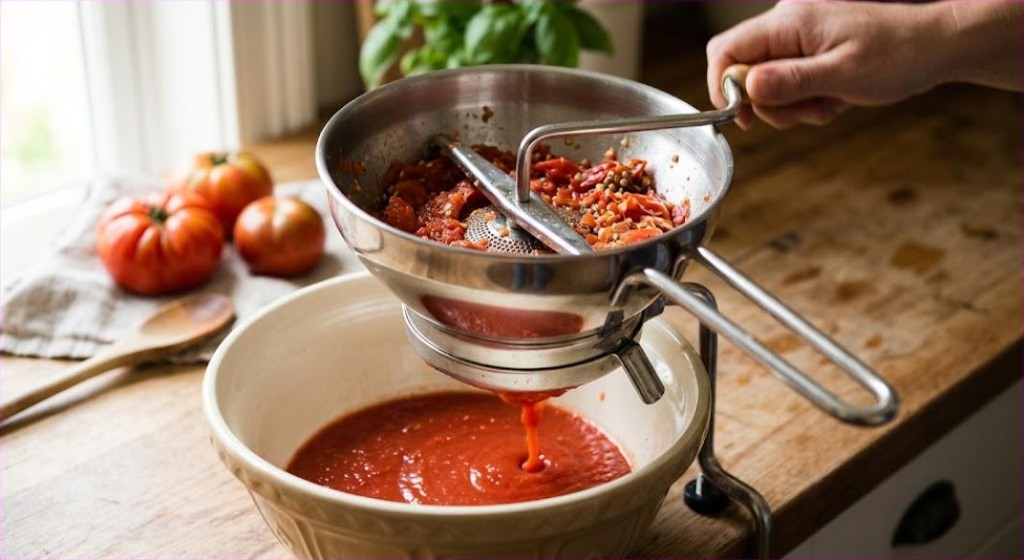
A food mill or tomato press separates skins and seeds from cooked fruit or vegetables while pureeing the rest, saving you from peeling a mountain of tomatoes by hand before making sauce. The main decision is manual hand-crank versus electric, and how much volume you typically process at canning time.
What Actually Matters
What these tools do that a blender cannot
A blender pulverises skins and seeds into the sauce; a mill or press separates and ejects them. That is the entire distinction, and it is why neither a food processor nor a high-powered blender replaces one. Tomato skins carry bitterness and seeds add a gritty texture, so removing them rather than chopping them finer is what produces a smooth sauce.
Volume decides manual versus electric
A hand-crank mill processes a few pounds comfortably and becomes tiring beyond that. An electric press handles a bushel without complaint but costs several times more and takes real cupboard space. The crossover point in practice is somewhere around one to two bushels a season: below it, cranking is fine; above it, the motor pays for itself in hand fatigue alone.
The Main Types and Who Each One Suits
Classic Hand-Crank Food Mill
The traditional stainless steel mill that clamps to a pot or bowl, with a hand-turned blade pressing food through a perforated disc to separate skins and seeds.
- Suits: Small to medium batches and general-purpose milling beyond tomatoes.
- Key features: Stainless steel construction, clamp-on stability, dishwasher-safe parts.
Multi-Disc Food Mill
Comes with several interchangeable perforated discs of different hole sizes, letting you choose between a coarse or very fine puree depending on the recipe.
- Suits: Cooks who want flexibility across different foods and textures.
- Key features: 3+ interchangeable discs, adjustable texture, versatile for sauces, soups, and baby food.
Electric Tomato Press / Strainer
A motorized version that feeds whole tomatoes in one end and separates juice and pulp from skins and seeds automatically, dramatically speeding up large canning sessions.
- Suits: High-volume tomato processing during harvest season.
- Key features: Motorized operation, continuous feed hopper, much faster than hand-cranking.
Stainless Steel Sauce Maker
A specific style of electric strainer optimized for sauce-making, often including interchangeable screens for different consistencies.
- Suits: Dedicated home sauce makers processing large tomato harvests.
- Key features: Interchangeable screens, stainless steel construction, high throughput.
Manual Tomato Press for Canning
A simpler manual press, sometimes auger-style rather than milling-disc style, built specifically around the tomato-to-sauce workflow for canning.
- Suits: Canning-focused cooks who don’t want an electric appliance.
- Key features: Auger or crank mechanism, canning-focused design, moderate batch size.
Compact Countertop Food Mill
A smaller, lighter version of the classic mill, suited to small kitchens or occasional use rather than big harvest-season batches.
- Suits: Small households or infrequent use.
- Key features: Lightweight, compact storage, lower cost than full-size mills.
Heavy-Duty Commercial-Style Strainer
Built for serious volume — larger hopper, more powerful motor, and sturdier construction aimed at those processing many pounds of produce per session.
- Suits: Serious home canners or small-scale producers.
- Key features: High-capacity hopper, powerful motor, built for repeated heavy use.
What I Use and Why
I use a hand-crank mill with interchangeable discs, and it does far more than tomatoes, which is what justifies keeping it. Applesauce and puréed soups both come out better through it than through a blender, and the fine disc makes a genuinely smooth raspberry purée without seeds.
The one season I processed a large tomato harvest with it, I regretted not borrowing an electric press. It took most of an afternoon and my forearm was done well before the tomatoes were.
How to Choose
Before comparing specific models, it helps to narrow the field on these points:
- Manual vs. electric operation
- Included disc sizes for different textures
- Capacity — how much you can process per batch or per hour
- Ease of disassembly for cleaning
- Stability while cranking, especially clamp-on models
If you’re only making a jar or two of sauce occasionally, a classic hand-crank mill is inexpensive and versatile beyond just tomatoes — it works for applesauce, squash, and baby food too. Once you’re processing a full harvest’s worth of tomatoes each season, the time saved by an electric strainer becomes hard to ignore. Whichever you choose, check how easily it disassembles for cleaning, since tomato pulp dries onto parts quickly if left too long.
Care and Common Mistakes
Disassemble and rinse immediately after use. Tomato pulp dries onto the disc perforations and the auger quickly, and once dry it has to be soaked and scrubbed out of every hole.
Check that clamp-on models are genuinely secured to the counter before you start cranking. A mill that shifts mid-turn spills pulp and is the main safety annoyance with these tools.
Dry the discs thoroughly. Thin perforated metal discs left damp will spot and, on non-stainless models, rust in the perforations where it is hardest to clean.
Frequently Asked Questions
What’s the difference between a food mill and a food processor?
A food mill separates skins, seeds, and fibrous bits from the puree as it processes food, which a standard food processor or blender can’t do — that’s what makes it useful for smooth tomato sauce or seedless berry puree.
Can a food mill replace peeling and seeding tomatoes by hand?
Yes, that’s its main purpose for tomato sauce making — cook the tomatoes whole (skins, seeds, and all), then run them through the mill, which leaves the skins and seeds behind and passes through the smooth pulp.
Is an electric tomato press worth it over a manual food mill?
It depends on volume — if you’re processing more than a bushel or two of tomatoes each season, an electric press saves significant time and hand fatigue. For occasional small batches, a manual mill is more economical and versatile.

Hi! I’m the creator of scooks (Simple Cooks).I share easy, practical recipes and simple cooking ideas to help you enjoy everyday home cooking with confidence.
Happy cooking! 🍽️