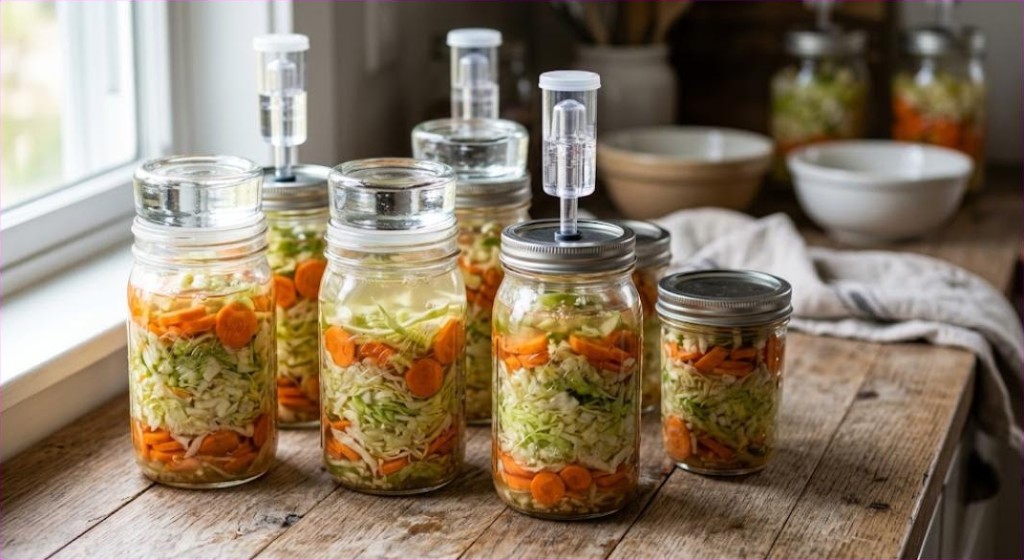
If a full-size fermentation crock feels like overkill, a mason jar kit gets you the same basic mechanics — airtight venting and a way to keep vegetables submerged — in a small, affordable format that reuses jars you probably already own. These kits are the easiest way to try fermenting without much upfront investment.
What Actually Matters
Wide-mouth versus regular-mouth is not interchangeable
Almost every fermentation kit on the market is made for wide-mouth jars, both because the lid diameter is standard and because you cannot realistically pack or unpack chunky vegetables through a narrow neck. Buying a kit and then discovering your jars are regular-mouth is the most common wasted purchase in this category.
Small batches ferment faster than you expect
A quart jar has far less thermal mass than a gallon crock and sits at room temperature throughout, so it reaches a given sourness noticeably sooner. Timings written for crock-sized batches will overshoot in a jar. Tasting early and often matters more here than following a schedule.
The Main Kit Types and Who Each One Suits
Basic Airlock Lid Kit
A simple lid with a small water-filled airlock chamber that screws onto a standard wide-mouth mason jar, letting gas escape without air getting back in.
- Suits: First-time fermenters who want the simplest possible setup.
- Key features: Fits standard wide-mouth jars, water airlock, minimal parts to clean.
Glass Weight and Lid Combo Kit
Pairs an airlock lid with a fitted glass weight designed to press vegetables below the brine line inside the jar.
- Suits: Keeping vegetables reliably submerged without improvising weights.
- Key features: Included glass fermentation weight, airlock lid, made for a snug fit inside the jar.
Wide-Mouth Fermentation Kit
Specifically sized for wide-mouth mason jars, which are easier to pack and unpack than regular-mouth jars when working with chunky vegetables.
- Suits: Fermenting whole or large-cut vegetables like cucumbers.
- Key features: Wide-mouth compatibility, easier packing, standard airlock mechanism.
Silicone Waterless Airlock Kit
Uses a small silicone valve instead of a water channel, so there’s no water to top up or spill, at the cost of being slightly less visually obvious that it’s venting.
- Suits: Low-maintenance fermenting without water refills.
- Key features: Silicone one-way valve, no water needed, compact low-profile design.
Multi-Jar Starter Set
Outfits several jars at once with matching lids and weights, letting you run multiple ferments in parallel — useful for testing different vegetables or seasonings side by side.
- Suits: Fermenting several small batches at once.
- Key features: Multiple lid and weight sets, consistent equipment across jars, good for experimentation.
Pump-Style Vacuum Fermentation Kit
Uses a hand pump to draw air out of the jar before fermentation begins, rather than relying on a continuous airlock throughout the process.
- Suits: A different approach for those who prefer an initial vacuum seal method.
- Key features: Hand pump included, vacuum-seal lid, distinct mechanism from standard airlocks.
All-in-One Fermentation Crock Lid Kit
A hybrid design that turns a standard mason jar into something closer to a mini crock, with a weighted lid system built specifically for longer, larger ferments in jar format.
- Suits: Bridging the gap between a jar kit and a full crock.
- Key features: Heavier-duty weighted lid, designed for extended ferments, still jar-compatible.
What I Use and Why
I use quart wide-mouth jars with silicone waterless airlock lids and glass weights, and for the volume I actually eat, that has been more practical than a crock. The waterless valves were the upgrade that mattered: the water-filled airlock caps I started with sloshed whenever I moved a jar and needed refilling.
The glass weights are worth buying rather than improvising. I spent a batch using a small jar of water as a weight, and it floated slightly, tilted, and let a corner of cabbage surface, which is exactly the failure mode weights exist to prevent.
How to Choose
Before comparing specific models, it helps to narrow the field on these points:
- Jar compatibility — wide-mouth vs. regular mouth
- Whether it uses a water airlock, silicone valve, or pump system
- Included weights to keep vegetables under the brine
- Number of jars the kit is designed to outfit
- Ease of cleaning and reusing between batches
Check the jar mouth size before buying — wide-mouth and regular-mouth mason jars use different lid diameters, and most fermentation kits are made for wide-mouth jars specifically. A glass or ceramic weight is worth having even if it’s sold separately, since improvised weights (like a smaller jar filled with water) are harder to keep clean and food-safe over a multi-week ferment. These kits work well for small batches — anything much larger than a quart or two is usually easier in a dedicated crock.
Care and Common Mistakes
Set jars on a plate or tray. Active ferments push brine up and out through the airlock in the first few days, and it will overflow.
Do not overfill. Leave at least an inch and a half of headspace above the brine so there is room for the vegetables to rise as gas is produced.
Wash silicone parts separately and check them for splits. A perished airlock gasket stops sealing without any visible sign during the ferment itself.
Frequently Asked Questions
Can I ferment in a regular mason jar without a special kit?
Yes — a jar with a loosely closed regular lid (burped daily to release pressure) and an improvised weight works, though a proper airlock kit is more consistent and requires less daily attention.
What size mason jar works best for fermentation kits?
Quart-size wide-mouth jars are the most common and versatile size for these kits, big enough for a useful batch of sauerkraut or pickles while still being easy to fit multiple jars in a fridge afterward.
How do I know if my mason jar ferment has gone bad?
A harmless white film on the surface can be skimmed off, but fuzzy mold in blue, green, black, or pink, or a rotten rather than sour smell, means the batch should be discarded.

Hi! I’m the creator of scooks (Simple Cooks).I share easy, practical recipes and simple cooking ideas to help you enjoy everyday home cooking with confidence.
Happy cooking! 🍽️